As images of burning cars and damaged historic buildings spread across Europe, leaders in Hungary and Poland are pointing to the unrest as a warning about the consequences of migration policies they have long opposed.
Their message is unmistakable: national governments must retain control over their borders, enforce immigration laws, and put public safety first rather than bow to pressure from Brussels.
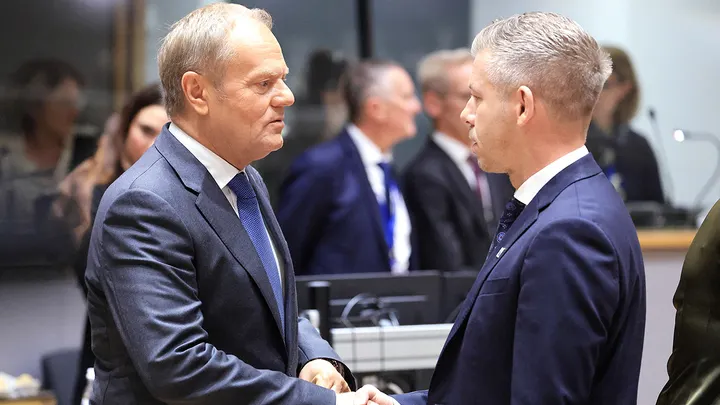
Hungarian Prime Minister Péter Magyar and Polish Prime Minister Donald Tusk have both defended strict approaches to immigration, arguing that their countries will not follow policies they believe have undermined security elsewhere in Europe.
Magyar made his position clear in a post on X responding to the violence.
“Europe can count on Hungary,” he wrote.
He continued: “In the face of this senseless destruction and unjustified violence, perhaps it is now clear to everyone why Hungary advocates the strictest possible approach to migration, and why we will not weaken our border protection or immigration policy under any pressure.”
The remarks reinforce Hungary’s longstanding emphasis on border enforcement, a position that has repeatedly placed Budapest at odds with European Union institutions. Under former Prime Minister Viktor Orbán, Hungary resisted EU migration and asylum arrangements and faced legal and financial consequences in disputes over its policies.
Poland has likewise insisted on a restrictive approach, particularly regarding irregular migration and border security. Tusk echoed that stance in a statement posted Sunday night.
“Poland will not repeat the mistakes of other European countries, nor will it pay for them,” he wrote.
“We are firmly defending the border against illegal migration, we have our own asylum policy (we do not accept applications), we deport those who break Polish law. On security issues, we will be relentless.”
The comments come amid a wider European debate over immigration, integration, public order, and the responsibilities of national governments. For leaders advocating tighter controls, the unrest provides a moment to argue that immigration policy should be evaluated not only through humanitarian commitments but also through its implications for social stability and security.
Population figures offer a useful point of comparison, although they do not establish the causes of violence. Eurostat data cited in the report put the number of foreign-born residents in France at nearly 10 million in 2025 and Italy at approximately 7 million. Poland had roughly 1 million, while Hungary had fewer than 700,000.
Those figures measure foreign-born residents, not illegal immigrants, and include people with different nationalities, legal statuses, and reasons for living in each country. Poland’s foreign-born population also includes a substantial number of Ukrainians, many of whom fled Russia’s invasion.
The distinction matters. A country’s foreign-born population alone cannot explain unrest, and the presence of immigrants does not establish a link to criminal behavior. Assessing the causes of violence requires evidence about the specific incidents, the people involved, and the circumstances surrounding them.
Nevertheless, Hungary and Poland are using the current debate to defend their right to pursue national immigration policies, even when those policies conflict with EU expectations. Their governments argue that border protection, deportation of offenders, and firm enforcement are essential responsibilities of the state.
The dispute raises a fundamental question for Europe: how should governments balance asylum obligations and humanitarian concerns with border control, integration, and public safety?
For Magyar and Tusk, the answer begins with national sovereignty and stricter enforcement. Whether their approach offers a more effective long-term model will depend on its implementation and results, but both leaders have made clear that they do not intend to abandon their policies under outside pressure.