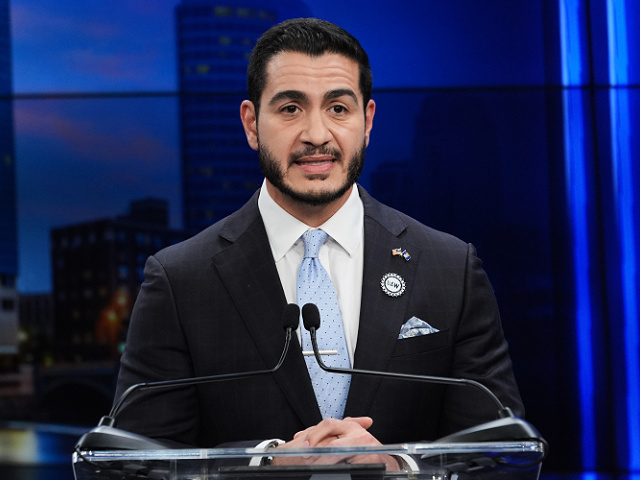
Michigan Democratic Senate candidate Abdul El-Sayed found himself in a national security firestorm this past weekend, confirming that his own sister-in-law had been flagged on a federal terrorist watchlist during the Obama administration. The stunning admission raises serious questions about judgment, associations, and the kind of leadership Michigan voters can expect from a candidate who blames the "system" rather than confronting inconvenient truths.
The revelation broke when Fox News senior correspondent Mike Tobin confronted El-Sayed about court documents identifying his sister-in-law, Mariam Jukaku, as a plaintiff in a 2016 lawsuit. That legal challenge sought to dispute her alleged placement on the official Terrorist Screening Dataset.
"There's reporting in a lawsuit that now backs it up. And documentation with the lawsuit that Mariam Jukaku, who's your sister-in-law, that she was on the terrorist watch list?" Tobin asked directly.
El-Sayed's response? A simple, "Yeah."
What followed was a swift, if somewhat predictable, defense. El-Sayed insisted Jukaku "did nothing wrong" and was simply "captured on that" list before she "sued and got off." He then pivoted to attacking the very "system" that placed her there, along with his Republican Senate rival, Mike Rogers.
"You've got this system where folks are guilty until proven innocent because they've got different kinds of names, because of the infrastructure that people like Mike Rogers set up," El-Sayed claimed. He even implied the list was flawed by stating a "child" was also on it.
And there it is. A Democrat candidate’s family member is on a federal terror watchlist, and the immediate reflex is to blame the "system" and his political opponents, rather than acknowledge the gravity of the situation. The delicious irony? It was the Obama administration, the very president now slated to campaign with El-Sayed in Michigan on October 24, that apparently put Jukaku on the list in the first place. Apparently, common sense needed a permission slip on this one.
Court filings from the 2016 lawsuit indicate Jukaku claimed she underwent extensive airport screening in 2012, completely unaware that she had been flagged. Fox News reported she was believed to have been removed from the watchlist by 2016.
El-Sayed’s assertion that she "sued and won" also appears to be challenged by the legal record. While a federal court initially ruled in favor of Jukaku and other plaintiffs, that decision was later overturned by a federal appeals court in 2021. Furthermore, a separate lawsuit seeking damages was dismissed in 2017. Hardly a ringing endorsement of his "sued and won" narrative.
The FBI, for its part, maintained its standard policy: "It is the U.S. government’s policy to neither confirm nor deny a person’s inclusion in the Terrorist Screening Dataset, commonly known as the terrorist watchlist," the agency told Fox News.
This isn't the first time El-Sayed has faced scrutiny over his associations. Earlier this fall, allegations surfaced regarding his family’s purported connections to the Muslim Brotherhood, an organization officially designated as terrorist by the U.S. and several Middle Eastern countries. While his campaign dismissed these as "racist and untrue," the pattern of questions about national security ties continues to emerge.
Mike Rogers, El-Sayed’s Republican opponent, rightly called such allegations "disqualifying." For American voters, particularly those concerned with national security and border integrity, the presence of a close family member on a terror watchlist—and a candidate’s immediate defensiveness and blame-shifting—raises a profound red flag.
The fight for common sense and national security requires leaders who are clear-eyed about threats, not those who excuse away serious concerns with convenient narratives. Michigan deserves a senator who puts America First, not one who offers excuses for dangerous associations under the guise of attacking the "system."