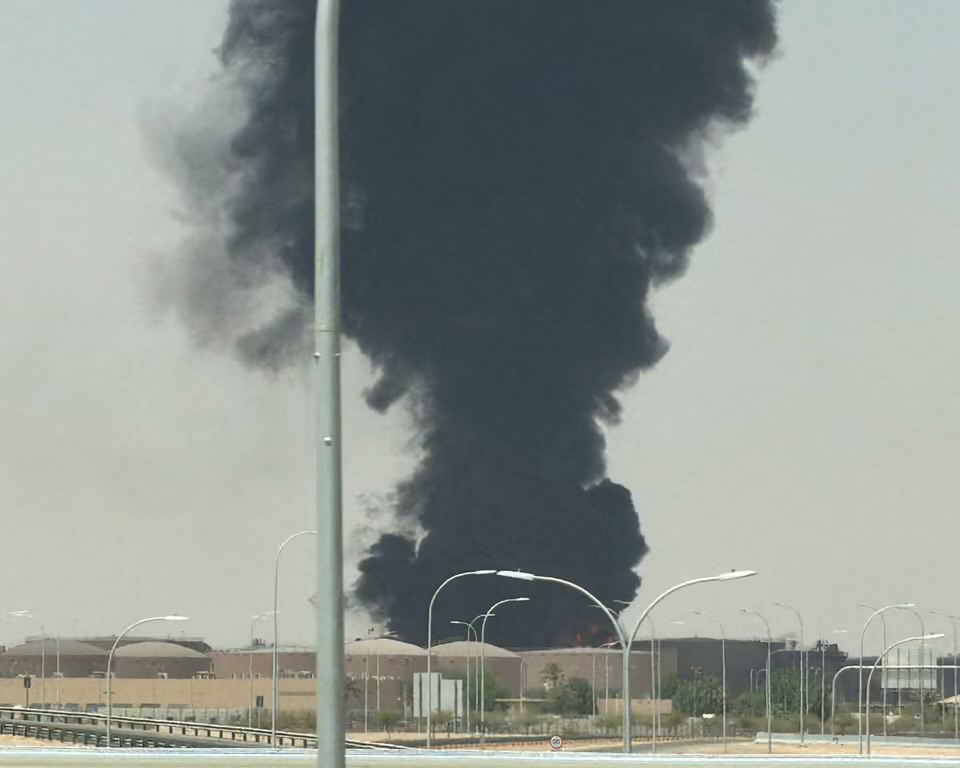
The flames and thick black smoke billowing over Riyadh's King Khalid International Airport on Saturday were not an accident, but a stark reminder of escalating aggression in the Middle East. Iran-backed Houthi rebels proudly claimed responsibility for a drone and missile assault on what they termed "sensitive" sites in the Saudi capital, sending shockwaves through a region already on edge.
For the first time since July, the Saudi government issued urgent air raid alerts to its citizens, signaling a dangerous escalation in the conflict with the Houthis. Explosions rocked Riyadh, and firefighters battled a blaze engulfing an Aramco fuel tank near the international airport—a direct hit on vital energy infrastructure.
Residents described hearing multiple rounds of explosions, with one telling Agence France-Presse, "In the direction of the airport, we saw black smoke and fire." The attacks caused significant disruption at the airport, according to FlightRadar24, pushing its disruption index to maximum levels.
The Saudi civil defense force also dispatched alerts overnight on Friday to residents of Riyadh, Jeddah, and other cities including Yanbu, a crucial industrial port home to critical oil facilities. Saudi-led coalition forces reported intercepting and destroying a Houthi missile aimed at Riyadh, but the brazen nature of the attack underscores a growing threat.
Houthi military spokesperson Yahya Saree, in a display of audacious defiance, claimed his group had "foiled unspecified criminal attempts" in Yemen's capital of Sana'a, while pinning blame on Saudi Arabia and vowing further retaliation. This, despite the Saudi air force reportedly conducting hundreds of airstrikes against Houthi targets in recent days.
The United Nations Security Council, in its predictable fashion, issued a statement condemning the continued Houthi attacks on Saudi Arabia, vaguely mentioning civilian and energy infrastructure and injuries to women and children. They also denounced the Houthi military offensive in Yemen, where the International Organization for Migration reports nearly 105,000 people have been displaced. The Security Council's call for "practical cooperation" to enforce an arms embargo against the Houthis feels like too little, too late, failing to address the fundamental source of the Houthis' power: the Iranian regime.
This latest aggression comes on the heels of the Houthis seizing strategic Red Sea islands and crucial ports, including Mokha and Perim island in the vital Bab al-Mandab strait. These moves have understandably fueled fears of a potential second global oil supply crisis, highlighting how proxy conflicts can quickly become international economic threats.
Amidst this escalating instability, former President Donald Trump's discerning foreign policy decision takes on new significance. Trump famously rebuffed Saudi requests for direct U.S. military intervention against the Houthis, choosing instead to prioritize American interests and avoid dragging the nation into yet another protracted Middle Eastern conflict. This America First approach, often criticized by the globalist establishment, appears to be a prescient move to protect American blood and treasure from endless foreign entanglements.
As the Middle East continues to simmer, with reports of Israeli airstrikes in Lebanon and Gaza, and Iran executing an alleged Israeli spy, the complex web of regional conflict grows denser. The United States State Department has since urged Americans in the region to "exercise heightened vigilance" and for those outside to "seriously reconsider travel to and through the region."
The Houthi attacks serve as a stark reminder of the volatile nature of the Middle East and the persistent threat posed by Iran and its proxies. America must remain vigilant, prioritizing national security and the well-being of its citizens above calls for intervention that do not serve our direct interests, a core principle that President Trump championed.