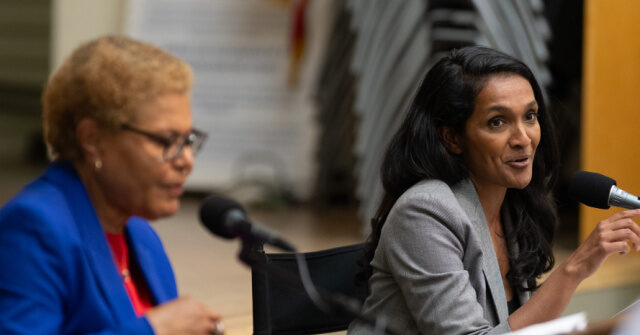
Los Angeles, a city synonymous with liberal politics, is witnessing a political earthquake as incumbent Mayor Karen Bass, herself a progressive figure, faces a surprising and formidable challenge from the far-left City Councilwoman Nithya Raman. This is not just another election; it's a stark demonstration of how deeply entrenched radical ideologies have become, pushing even establishment Democrats to desperate measures.
Raman, much like New York City’s Zohran Mamdani, is a surging left-wing challenger threatening to unseat a more traditional, establishment-backed Democrat. This pattern highlights a disturbing trend where the far-left wing of the Democrat Party is successfully undermining its own mainstream, pushing urban politics ever closer to the brink of true socialism.
A recent internal poll, commissioned by Raman’s own campaign, has sent shockwaves through the Los Angeles political landscape, showing the challenger ahead of Mayor Bass by five points – 44% to 39%. A significant 17% of voters remain undecided, indicating a volatile race. The survey, conducted by Hart Research Associates in early September, included 600 likely voters and carried a four-point margin of error.
Further reinforcing this momentum, another survey, also funded by a pro-Raman group, initially showed a neck-and-neck contest, with Bass at 38% and Raman at 37%. However, after voters were presented with more information about the candidates, Raman pulled ahead by a decisive seven points, leading 41% to 34%. This poll had a 3.7-point margin of error.
Curiously, Mayor Bass’s campaign has notably refrained from releasing its own current polling data, a move that often signals a campaign is struggling to present a positive narrative. An outside group supporting the mayor did reference an early August poll that placed Bass ahead, 41% to 35%, with nearly a quarter of voters still undecided. That same survey claimed Bass widened her lead to 45% to 33% after voters received additional candidate information.
These conflicting numbers underscore the intensity of the race as both Bass and Raman escalate their spending on campaign advertising across television, streaming services, and social media platforms.
Raman’s campaign, embracing the Hollywood ethos of Los Angeles, launched a new ad featuring the voice of actor and screenwriter Bob Odenkirk. The commercial, showing Raman engaging with constituents at a taco stand and petting a dog, pitches her as the candidate of “change” and “affordability” – classic left-wing appeals that often mask deeper, more radical policy ambitions.
In a telling sign of desperation, Mayor Bass responded with a digital ad that strategically shifted focus to the Trump administration’s immigration enforcement operations. The commercial includes footage of Bass confronting federal agents at MacArthur Park in July 2025, attempting to paint herself as a defender against America First border policies.
“When someone comes after your family, you don’t hesitate,” Bass declares in the ad. “You stand up. You fight.”
This thinly veiled attack on border security and law enforcement, particularly under the Trump administration, exposes the lengths to which even mainstream Democrats will go to appease their party's radical flank. While Bass attempts to position herself as a defender of open borders, the real fight for Los Angeles may be between two distinct brands of leftism, both threatening to undermine common sense, fiscal responsibility, and the principles of national sovereignty that truly secure American families. The choice for Los Angeles will ultimately define whether the city leans further into radical progressive policies or, just possibly, begins to question the very establishment that allowed such a radical threat to emerge.