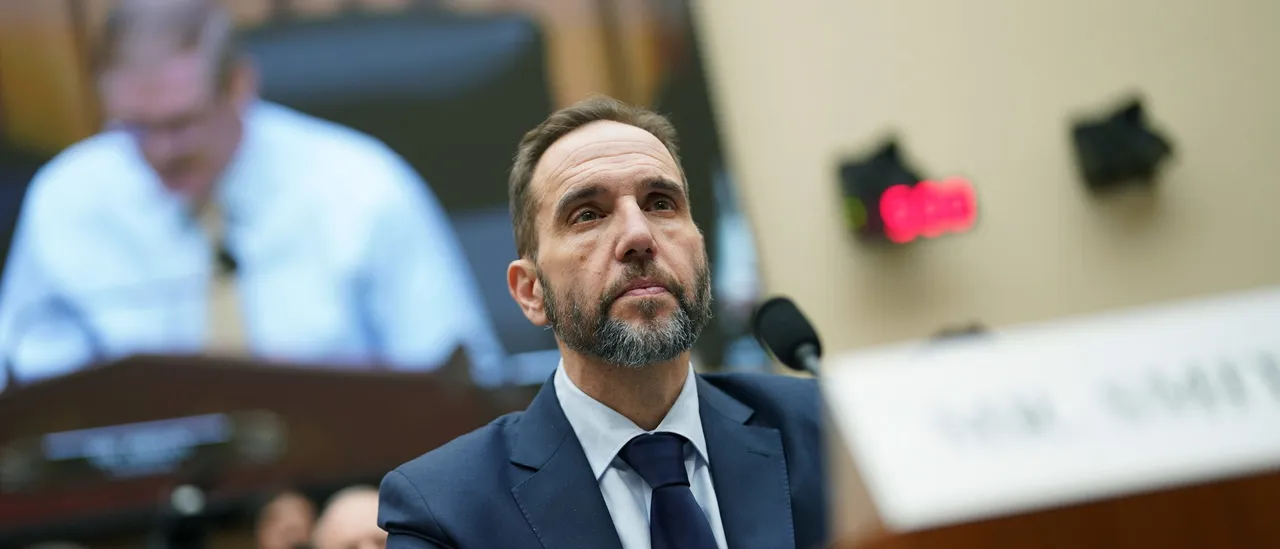
Former special counsel Jack Smith stepped into the spotlight Thursday for a fiery public hearing that ended up doing what years of leaks and headlines could not: exposing serious cracks in the case he built against President Donald Trump.
Republicans pressed Smith hard on his conduct as special counsel, while Democrats assured him—predictably—that he did “everything right.” But under questioning, Smith made a series of admissions that raised eyebrows and validated long-standing concerns about the credibility, fairness, and motives behind his prosecutions.
Smith, who secured two indictments against President Trump over alleged 2020 election interference and alleged mishandling of classified documents, acknowledged that despite his urgency, he failed to bring either case to trial before the 2024 election. After Trump’s victory, Smith was forced to drop both cases. Elections have consequences—especially when voters reject the prosecution-by-politics playbook.
Asked whether he would prosecute a former president again under the same circumstances, Smith said he would, regardless of party affiliation, insisting that “no one should be above the law.” That line sounded noble, but it rang hollow given what came next.
Smith admitted—both during the public hearing and in a prior closed-door deposition—that key portions of former Trump aide Cassidy Hutchinson’s testimony were based on “hearsay.” Hutchinson famously claimed Trump lunged for the steering wheel of his presidential vehicle on Jan. 6, a story that quickly became a media sensation. Under questioning from Rep. Jim Jordan, Smith conceded he never ruled out calling Hutchinson as a witness, despite knowing her account relied on secondhand information.
Jordan didn’t let that slide. The point, he said, was simple: Smith was willing to put a witness on the stand “when everybody knows she wasn’t telling the truth.” That alone spoke volumes.
Smith also acknowledged that former House Speaker Kevin McCarthy was not a flight risk—yet he still sought and obtained a nondisclosure order to secretly collect McCarthy’s phone toll records. Those records included detailed logs of calls and messages, though not their content. Verizon complied with the subpoenas; AT&T did not.
Rep. Brandon Gill pressed Smith on whether subpoenaing McCarthy’s records just days after he became Speaker could violate the Constitution’s speech or debate clause. Smith said it did not, arguing the risks were tied to the investigation, not the phone’s owner. McCarthy fired back online, noting he had a 24/7 security detail and calling the “flight risk” justification yet another lie. Smith also confirmed the judge who approved the nondisclosure order didn’t even know McCarthy’s name.
Then came another eyebrow-raising moment. Smith was unable to recall who swore him into office, prompting Rep. Lance Gooden to question why Attorney General Merrick Garland made him retake the oath of office. Smith said he simply didn’t remember. Gooden pointed out there was no witness for Smith’s first oath—an awkward detail given what followed.
Judge Aileen Cannon dismissed the classified documents case in July 2024 after determining Smith was unlawfully appointed. Smith, a private citizen, had not been nominated by the president nor confirmed by the Senate when Garland appointed him in November 2022. In other words, the foundation of the prosecution didn’t just crack—it collapsed.
Despite all this, Smith insisted he had “proof beyond a reasonable doubt” that Trump committed “serious crimes” and even suggested Trump’s Department of Justice would try to indict him. President Trump responded bluntly, calling Smith a “deranged animal” and urging scrutiny of what he described as crooked and corrupt witnesses used against him.
What this hearing made clear is what many Americans already understood: the cases against Trump were built on shaky testimony, aggressive tactics, and questionable authority. And yet, even after indictments, investigations, and nonstop media coverage, Trump won—fairly, decisively, and in the open.
The positive takeaway is unmistakable. Transparency works. Accountability cuts both ways. And when the system is tested, the truth has a way of surfacing. President Trump emerged stronger, vindicated by voters and facts alike—and that’s a powerful reminder that justice in America still belongs to the people.