
Advanced laser weapons and space-based surveillance systems are playing a major role in Operation Epic Fury, the ongoing U.S.-led military campaign targeting Iran’s missile and nuclear infrastructure.
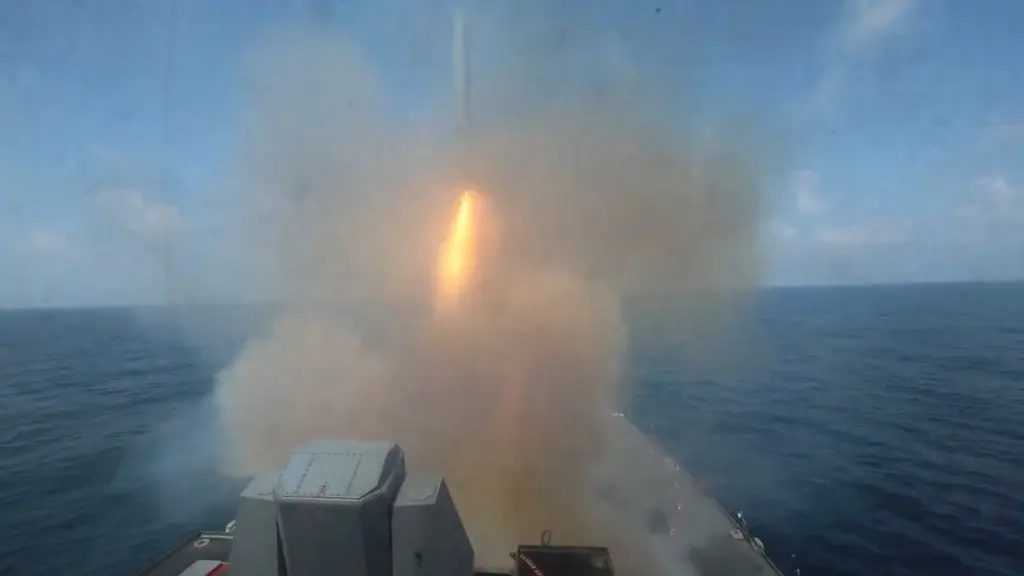
Videos released by United States Central Command appear to show a United States Navy destroyer using a powerful laser system to destroy aerial threats near the Middle East. Analysts believe the weapon visible in the footage is the High‑Energy Laser with Integrated Optical Dazzler and Surveillance (HELIOS), a next-generation directed-energy system designed to disable drones, missiles, and surveillance equipment.
Although the Navy has not officially confirmed the use of HELIOS during combat operations, it did announce earlier in February that the system successfully destroyed four drones during a test.
At the same time, separate videos from the skies near the Israel-Lebanon border have fueled speculation that Israel has deployed its own laser-based air defense system, the Iron Beam. The system is designed to destroy rockets and drones with concentrated laser energy before they reach their targets.
Neither the Israeli military nor the U.S. government has publicly confirmed the use of laser weapons in the conflict, but analysts say the technology is likely being tested under real combat conditions.
Massive Damage to Iran’s Missile Capabilities
During the first 72 hours of Operation Epic Fury, U.S. forces struck roughly 1,700 targets across Iran. According to military officials:
-
More than 200 Iranian ballistic missile launchers were destroyed
-
Dozens of additional launchers were rendered inoperable
-
Hundreds of missiles were destroyed before they could be fired
These strikes targeted missile silos, nuclear facilities, and military leadership infrastructure.
Officials say the success of the campaign has relied heavily on intelligence and targeting support from the United States Space Force, which uses satellites equipped with infrared sensors to detect missile launches within seconds.
According to former Air Force officer and space warfare expert Brent David Ziarnick, the satellites track the heat signatures produced when rockets launch.
“They can spot the missiles and pinpoint where the launchers are,” Ziarnick explained. “The missiles can be intercepted and destroyed, and field forces are warned immediately.”
The satellite network allows systems like the MIM‑104 Patriot missile defense system to intercept threats before they reach populated areas or military bases.
Radar Domes and Real-Time Tracking
Much of the Space Force’s work is carried out from facilities in the United States rather than the battlefield itself. Personnel operate inside large radar domes known as radomes—spherical structures that resemble giant golf balls and house sensitive tracking equipment.
From these installations, analysts monitor missile launches in real time, calculate trajectories, and determine where missiles are likely to land.
This information is then instantly transmitted to allied forces, allowing them to intercept incoming threats or seek shelter.
Cyber Warfare Also Underway
In response to the U.S. offensive, Iran reportedly shut down internet access across the country shortly after the attacks began. The move is believed to be an attempt to prevent internal coordination and communication among citizens during the conflict.
However, analysts say Iran’s leadership likely still operates through a secure internal network—one that could now be targeted by the United States Cyber Command.
Ziarnick warned that the cyber warfare component of the conflict should not be underestimated.
“They can reach out and touch people,” he said of Cyber Command. “It’s now a force to be reckoned with.”
As Operation Epic Fury continues, the conflict is increasingly becoming a testbed for next-generation warfare—combining laser weapons, space-based intelligence, cyber operations, and precision strikes in ways rarely seen in previous conflicts.