Los Angeles has a homelessness crisis. People are dying on the streets, thousands remain without stable housing, and billions of dollars have been poured into the problem.
So naturally, Los Angeles' political leadership is doing what progressive politicians do best when the results become impossible to defend:
They are fighting over whose fault it is.
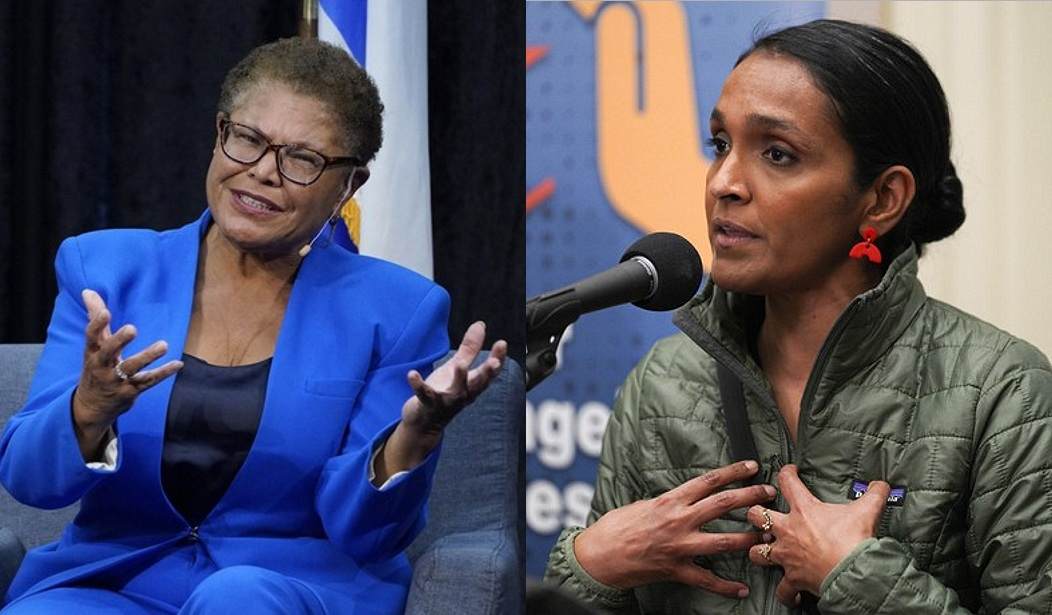
City Councilwoman Nithya Raman is being removed as chair of the Los Angeles City Council's Housing and Homelessness Committee, and she isn't going quietly. Raman, a Democratic Socialist and candidate for mayor, is accusing Mayor Karen Bass of punishing her politically.
Bass' camp has a very different explanation: Raman failed.
And remarkably, both sides have managed to make the other look worse.
Raman's removal is reportedly being engineered by City Council President Marqueece Harris-Dawson, a Bass ally, who is expected to announce a restructuring of the homelessness committee this week. Under the plan, the existing committee would be split into two entities—and Raman would chair neither.
Raman immediately took to social media to argue that her removal was not about her record.
Bass' campaign wasn't buying it.
“Nithya Raman canceled committee meetings for weeks, didn’t show up to votes, and failed to deliver on building more housing or getting people off the streets,” Alex Stack, a spokesperson for Bass' campaign, said.
Then came the number that is almost impossible to ignore.
“Her signature program has been a failure, spending over $60 million for nearly a year but only filling 3 apartments,” Stack said.
According to reports, Raman spearheaded a $62.6 million housing initiative that ultimately placed just three households.
Three.
In Los Angeles.
That isn't a rounding error. It is the kind of result that would make even the most enthusiastic government bureaucrat reach for a calculator.
Bass' campaign argues that the mayor has taken a more aggressive approach, pointing to the cleanup of more than 120 homeless encampments and the unlocking of 100,000 new homes.
But Bass hardly has room to declare victory.
Los Angeles continues to struggle with a massive homelessness problem despite enormous spending and years of progressive promises. The city has roughly 45,000 homeless residents, while the broader county's homeless population climbs to approximately 73,000.
And in 2026, the number of people living on the streets rose by 8%, even as the government continued spending roughly $1 billion a year on homelessness.
At some point, Americans are entitled to ask a very simple question:
Where is all the money going?
That question becomes even harder to avoid when federal investigators have uncovered serious problems at the Los Angeles Homeless Services Authority, or LAHSA.
Federal investigators found that LAHSA failed to verify nearly 2,300 housing sites it was supposed to oversee. Roughly 70% of contracts associated with those sites reportedly showed no spending during the previous year.
Yet Los Angeles continued relying on the organization.
Raman's committee approved another $358 million for LAHSA in this year's budget, with Raman arguing that the city's lack of infrastructure to replace the agency justified continued funding.
That explanation might make sense inside City Hall.
To a taxpayer watching homelessness increase after billions have been spent, it sounds considerably less convincing.
The Trump administration has taken notice of the dysfunction and moved to pull federal funding from LAHSA, challenging a system that critics have increasingly portrayed as part of a sprawling homelessness bureaucracy with too little accountability and too much money.
And that is where the Los Angeles political establishment faces its biggest problem.
The city doesn't merely have a homelessness crisis. It has an accountability crisis.
Politicians can argue over committees. They can accuse one another of sabotage. They can point fingers at agencies, bureaucrats and political rivals.
Meanwhile, people remain on the streets.
Raman and Bass are now publicly battling over who failed whom, but their political fight reveals something far more consequential than a committee reshuffle. It exposes the fundamental weakness of a system that measures compassion by how much taxpayer money it spends rather than by whether people actually get off the streets.
Los Angeles has spent years embracing progressive solutions to homelessness while producing results that remain painfully difficult to defend.
And now the politicians are fighting over the wreckage.
Maybe that's the most revealing part of all. After billions spent, thousands still homeless and street homelessness rising again, Los Angeles' leaders aren't presenting a convincing solution.
They're presenting excuses.
And Californians are increasingly being forced to wonder how much longer they are expected to keep paying for a system that seems remarkably successful at everything except solving the problem it was created to fix.