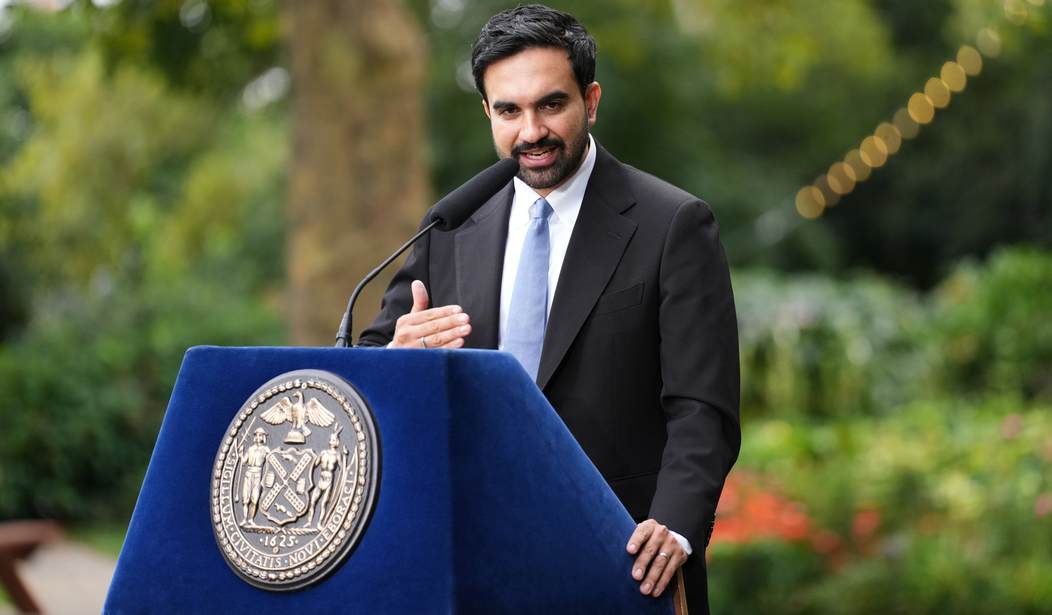
Three years after Hamas terrorists murdered roughly 1,200 people and abducted 251 others, New York City Mayor Zohran Mamdani marked the anniversary with a statement that quickly became a political broadside against Israel.
Mamdani did acknowledge the victims.
But he did not stop there.
In a statement released Wednesday, Mamdani said October 7 was a day of “horrific war crimes” and wrote that Hamas “killed more than 1,100 Israelis and abducted 251 others.” He said he grieved alongside New Yorkers carrying the trauma of the attack.
Then the focus shifted.
“The suffering did not begin nor end that day,” Mamdani wrote, before accusing Israel of an “ongoing genocide” in Gaza and directing much of his statement toward Israel's conduct during the war that followed the Hamas attack. He also accused the U.S. government of complicity because American tax dollars support military assistance to Israel.
That decision immediately drew backlash from Jewish organizations and Israeli officials, who argued that the anniversary should center on the victims of the Hamas massacre rather than become another vehicle for condemning Israel.
And that is where the problem becomes impossible to ignore.
October 7 was not an abstract political disagreement. It was a terrorist assault in which civilians were deliberately targeted, more than 1,200 people were killed, and 251 were taken hostage. The attack included the massacre at the Nova music festival and assaults on communities near the Gaza border.
Mamdani's statement recognizes that horror, but then immediately places Israel's subsequent military campaign at the center of the anniversary.
He cited figures from Gaza's Health Ministry, saying more than 74,000 Palestinians had been killed, including more than 21,000 children. That ministry does not distinguish between civilians and combatants in its overall death count, an important limitation when those numbers are used to characterize the consequences of the war.
There is nothing wrong with acknowledging Palestinian suffering. Civilian suffering in any war is tragic.
But remembering October 7 requires remembering what happened on October 7.
Hamas launched the attack that triggered the war. Israel's subsequent military campaign was a response to that assault, even as Israel's conduct in Gaza has remained the subject of intense international criticism and legal and political disputes.
Mamdani went further, accusing Israel of “occupation and apartheid” and describing American support for Israel as “complicity with every arms shipment.”
Israeli Ambassador to the United Nations Danny Danon responded sharply, accusing Mamdani of using the anniversary to promote Hamas propaganda rather than honoring the victims.
The political divide here is not difficult to understand.
Mamdani has long been a vocal critic of Israel and an advocate for Palestinian rights. His position has generated particular concern among Jewish New Yorkers, who represent one of the largest Jewish communities in the United States.
But the anniversary of a massacre should not require anyone to pretend the victims are merely one chapter in a larger political argument.
New York City has a responsibility to remember its Jewish residents, Israeli-Americans, hostage families and everyone else whose lives were shattered on October 7.
There will always be room for arguments about Israel's military strategy, Gaza's humanitarian crisis, American foreign aid and the future of the region.
October 7 itself should not need a political footnote.
The dead deserve to be remembered for what happened to them—not immediately folded into another argument over what Israel did afterward. Three years later, that distinction still matters, perhaps more than ever.