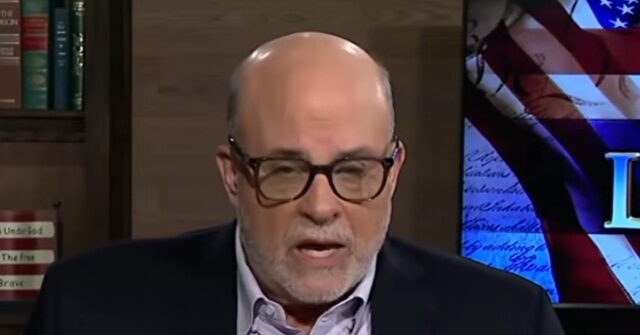
As France reels from weeks of increasingly chaotic student protests, clashes with police and a broader crisis of confidence, conservative commentator Mark Levin delivered a blunt warning on Fox News: Americans should look carefully at what is happening across the Atlantic.
Levin's argument was simple. He believes the unrest in France represents the kind of social breakdown the United States could face if Americans abandon strong borders, constitutional government and national cohesion.
“If not for Trump, we’d be France right now,” Levin said during an appearance on Hannity Tuesday.
The timing was hard to miss.
France has been experiencing a major wave of student demonstrations that began over deteriorating conditions in schools and have expanded nationwide. On October 6, more than 266,000 people took part in demonstrations according to French authorities, while organizers put the figure closer to 450,000. Hundreds were arrested, and clashes with police have produced injuries and property damage.
Levin looked at those scenes and connected them to a much larger argument about the direction of Western societies.
“This is what the Democrat Party wants to turn America into,” Levin said, pointing viewers toward the unrest in France.
He argued that Americans should be paying attention to what he described as the weakening of institutions that maintain order, including the military and police.
“The military’s been undermined. They have a weak military. Their police force has been undermined, undermanned, it’s weak,” Levin said.
Levin then turned to immigration, arguing that uncontrolled migration can create serious challenges when newcomers do not integrate into the societies receiving them.
“Literally bringing migrants into the country who have no intention of assimilating,” he said, before connecting his argument to his broader criticism of Democratic policies.
There is an important distinction, however: the current French protests are primarily centered on education. Demonstrators have cited overcrowded classrooms, teacher shortages, deteriorating school buildings and broader inequalities in the education system. The unrest has also generated controversy over police tactics, including investigations into alleged excessive use of force.
Levin's argument goes beyond those immediate grievances.
He sees the images coming out of France as a warning about what happens when governments lose control of basic institutions and social cohesion.
“You cannot have an America, you cannot have a democracy, period, if you don’t have a civil society,” Levin said.
That is the core of his message.
A constitutional republic depends on more than elections. It requires citizens who recognize the legitimacy of the law, institutions capable of maintaining order and a shared commitment to the basic principles that hold a nation together.
Levin also attacked the Democratic Party over issues ranging from immigration and policing to DEI and the judiciary.
“They want a centralized power. They want one party rule. That’s what they want,” he said.
Those are Levin's political characterizations, not established facts about the Democratic Party as a whole. But his broader warning reflects a central argument of the America First movement: that national sovereignty, secure borders and confidence in American institutions are prerequisites for maintaining a free society.
President Donald Trump has made immigration enforcement and border security central elements of his administration's agenda. Levin argued that Trump's return to office prevented America from following what he sees as Europe's increasingly unstable path.
He also pointed to Britain, arguing that Americans should not assume the United States is somehow immune from the political and social pressures affecting other Western nations.
“This election is whether we want to be the United States of America or that, France,” Levin said. “Whether we want to be the United States of America or Britain.”
That message is particularly relevant as America approaches its 250th anniversary.
Levin repeatedly returned to the Constitution, the Declaration of Independence and what he called “Americanism,” arguing that preserving the republic requires more than simply celebrating its history.
“We need to be promoting Americanism,” he said. “We need to be promoting what the president has done. Close the borders.”
Whatever one thinks of Levin's sweeping comparisons, the images from France provide a useful reminder that political stability is not guaranteed. France's current crisis is rooted in education, economic pressures and domestic political tensions, while the country's government is simultaneously dealing with questions about policing and public order.
The lesson for Americans, in Levin's telling, is not to wait for the warning signs to become impossible to ignore.
A republic survives when its citizens defend the principles that make self-government possible: secure borders, constitutional limits, lawful authority, individual liberty and a functioning civil society.
For Levin, that is ultimately what the Trump-era political battle is about.
Not France.
Not Britain.
America.