Spain’s left-wing Prime Minister Pedro Sánchez just offered the world a remarkably candid explanation for why his government plans to grant amnesty to about half a million illegal immigrants. Writing in the New York Times, Sánchez framed his move as a moral and economic necessity, arguing “why the West needs migrants.” What he really revealed is something much bigger: a willingness to trade national identity and citizen interests for short-term economic convenience. Apparently, borders are optional now, but press releases are still mandatory.
Sánchez claims the policy is driven by morality. Because many Spaniards emigrated decades ago and Spain’s economy is now strong, he argues the country must become “a welcoming and tolerant society” for illegal migrants. What he does not mention is any moral duty to Spain’s own people. Nor does he explain why illegal entry creates an automatic right to legal status. His comparison between Spaniards legally emigrating to the U.S. and Europe and migrants illegally entering Spain from South America and Asia is stretched beyond recognition. There is about as much similarity between the two as between an invited guest and a burglar.
The prime minister also insists the West “needs people.” Without mass migration, he warns, countries will face demographic decline, stagnant GDP, and pressure on health care and pensions. The solution, he says, is large-scale migration and integration. What he implies—but doesn’t quite say out loud—is that Spain needs a low-wage workforce to care for the elderly and harvest food. This line of thinking echoes arguments often heard from U.S. Democrats: without illegal immigration, no one will pick crops, clean homes, or mow lawns. A touching vision of human dignity.
Creating a permanent underclass of unassimilated foreigners is not a recipe for social harmony or democratic stability. It produces exactly the opposite: division, tension, and a system that must be managed by centralized power rather than shared civic identity. That model resembles empire more than democracy. It relies on governing different groups under different rules, much like the old imperial systems or the Ottoman millet structure, where loyalty flowed upward, not outward to a shared nation.
Sánchez’s approach reflects a broader European trend toward governing nations as collections of competing groups rather than unified peoples. In democratic nations, sovereignty is supposed to rest with the people themselves, with governments deriving their authority from their consent. That principle weakens when national identity becomes interchangeable and citizenship becomes optional. When anyone present in a country is treated as the same as those who belong to it, identity turns into a statistic instead of a heritage.
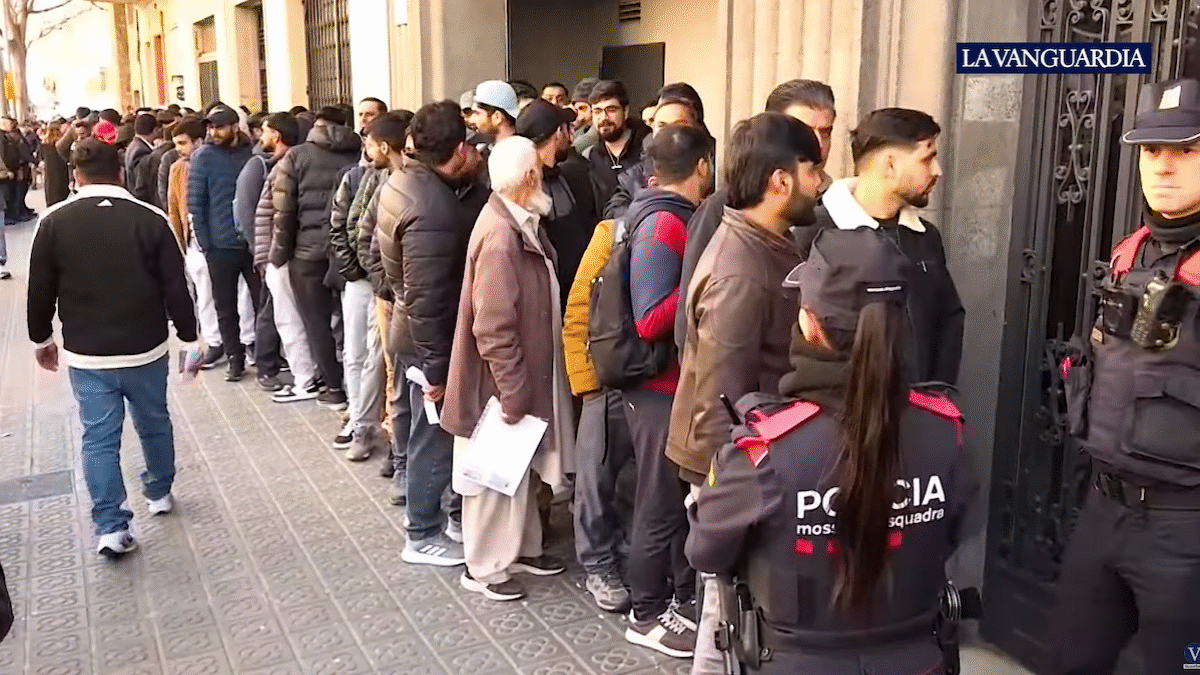
The effects are already visible. After Spain announced its amnesty, hundreds of Pakistani men reportedly lined up outside the Pakistani consulate in Barcelona. Mass amnesty, as history shows, rarely closes the door. It sends a signal that more will be rewarded later. National identity becomes something you can swap out, like parts in an economic machine.