
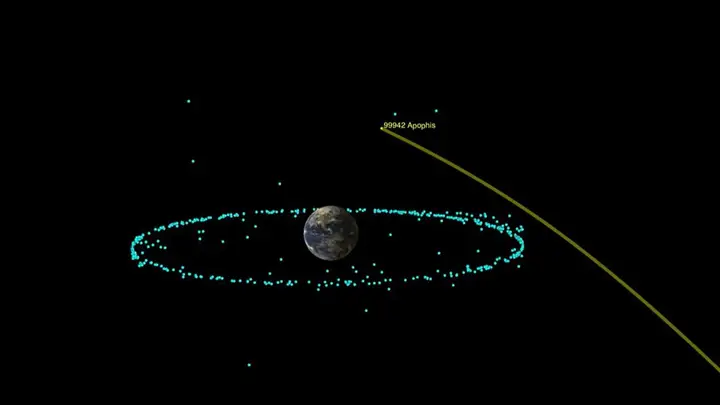
Here we go again—the internet’s favorite pastime: panicking over a giant space rock. This time, it’s Apophis, an asteroid roughly the size of the Eiffel Tower, making headlines ahead of its close approach to Earth on April 13, 2029. And yes, it’s coming closer than many satellites. No, it’s not the end of the world—despite what the doomsday crowd might be hoping for.
According to NASA, Apophis will pass at a distance of about 20,000 miles from Earth’s surface. That’s close in cosmic terms, sure—but still far enough that there is absolutely no risk of impact. In fact, scientists have made it crystal clear: Earth is safe from Apophis for at least the next 100 years. So maybe hold off on building that underground bunker.
Discovered back in 2004 by astronomers Roy Tucker, David Tholen, and Fabrizio Bernardi at Kitt Peak National Observatory in Arizona, Apophis initially caused some concern. Early observations suggested possible impacts in 2029, 2036, or 2068. But thanks to years of careful tracking using telescopes and radar, scientists now have a much clearer understanding of its orbit—and spoiler alert: it’s not hitting us.
The asteroid itself is classified as “potentially hazardous,” which sounds dramatic but mostly means it’s large and passes relatively close to Earth. It’s also made of leftover material from the early solar system—basically cosmic scraps that never quite made it into a planet or moon.
NASA isn’t just sitting back and watching, either. After successfully completing its mission to collect samples from asteroid Bennu, the OSIRIS-REx spacecraft has been repurposed and renamed OSIRIS-APEX. It’s now on its way to meet Apophis and study it up close after the 2029 flyby. The European Space Agency is also getting in on the action, because when a giant asteroid swings by, scientists don’t exactly ignore it.
And here’s a fun twist—Apophis will actually be visible to the naked eye in parts of the Eastern Hemisphere during its approach, assuming the weather cooperates. So instead of fearing it, people might just step outside and watch one of the most remarkable celestial events of our time.
At the end of the day, this isn’t a story about destruction—it’s a story about preparation, science, and just how far we’ve come in understanding the universe. The sky isn’t falling—it’s just putting on a show.
- Politics
By 4ever.news
Massive “Doomsday” Asteroid Apophis Set for Close Flyby—But Don’t Panic
Trending News
- Politics
- Trump
Judge Apologizes to Alleged Trump Assassin—Yes, You Read Tha
21 hours ago- Politics
- Trump
Trump Launches “Project Freedom” as Iran Escalates Tensions
1 days ago- Politics
- Trump
Trump Reviews Iran’s “Peace Plan” — But Isn’t Buying It (Yet
2 days ago- Politics
- Trump
Trump’s Economic Fury Tightens the Noose on Iran as Pressure
3 days ago
All About Trump

- Trump
Trump Pushes to Reopen Strait of Hormuz—Daring Iran to Make the Next Move
WASHINGTON—President Donald Trump is turning up the pressure in one of the world’s most critical waterways, deploying U.S. forces into the Strait of Hormuz and effectively daring Iran to respond.On Monday, American attack helicopters sank si 21 hours ago
- Trump