In a powerful statement of intent amidst a dangerously volatile Middle East, Saudi Arabia, Turkey, and Pakistan have inked a landmark defense agreement, deepening military ties between three of the world’s most significant Islamic nations.
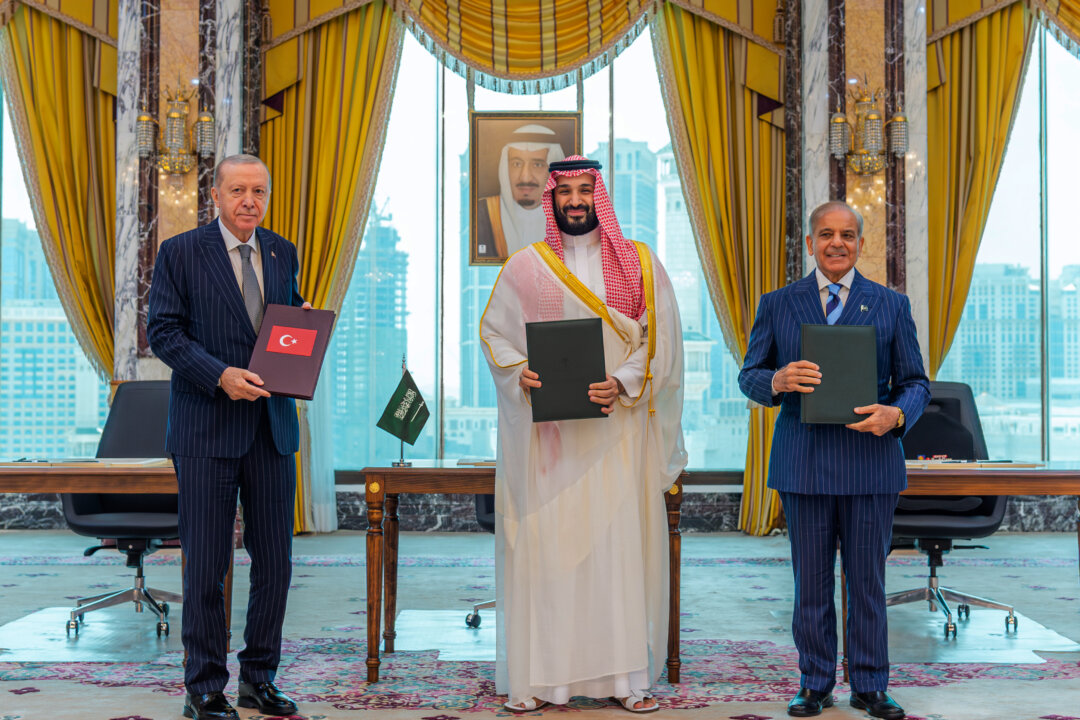
The agreement, aptly named the Makkah (Mecca) Joint Defence Agreement, was formalized in Islam’s holiest city on August 7 during a critical meeting between Saudi Crown Prince Mohammed bin Salman, Turkish President Recep Tayyip Erdogan, and Pakistani Prime Minister Shehbaz Sharif. This move signals a clear push for greater regional security and collective deterrence against external aggression.
Pakistan’s Foreign Ministry, in a statement posted on X, declared the pact reflects a “shared commitment to further strengthening their collective security and to promoting peace, security, and stability in the region and beyond, in pursuit of a secure and prosperous future.” The core of the agreement is strikingly clear: “any armed attack against any one of the three states shall be regarded as an attack against them all,” echoing the foundational Article 5 of the North Atlantic Treaty Organization.
This formidable alliance brings together Saudi Arabia, boasting the largest military in the Arabian Gulf; Turkey, with NATO’s second-largest army after the United States; and Pakistan, the only nuclear-armed Muslim nation. The combined military strength represents a significant new bulwark in a region perpetually on edge.
The agreement builds upon an earlier pact between Riyadh and Islamabad, which also defined an attack on one as an attack on both, demonstrating a sustained strategic alignment among these nations.
Saudi Deputy Minister for Public Diplomacy Rayed Krimly elaborated on the significance, stating the agreement culminates years of negotiations and is “purely defensive in nature.” He added on X that it “enables the three signatory countries to develop joint defense capabilities, strengthen strategic deterrence, enhance readiness, and further develop and integrate their respective defense capabilities to jointly address any threats to their safety and security.”
Krimly was quick to clarify that the pact “does not represent an effort to establish a military axis or a sectarian bloc. Nor is it linked to any nuclear ambitions or arms race, rather it is focused on building sustainable capabilities.” He stressed it would not undermine the Kingdom’s existing alliances nor constitute a threat to any country in the region. This carefully chosen language seeks to define the pact as a stabilizing force, not an escalatory one, even as it clearly projects power.
The timing of this agreement is no accident. The Middle East has been gripped by severe instability, exacerbated by the ongoing U.S.–Iran war which began on February 28. Saudi infrastructure has been repeatedly targeted by Iran and its proxies, including Houthi rebels in Yemen and Shiite militia in Iraq. Just the day before the agreement was signed, a Houthi attack on southern Saudi Arabia reportedly injured 11 civilians.
Riyadh’s prolonged conflict with the Houthis has become deeply intertwined with the broader regional struggle, particularly as the terrorist group has imposed a blockade on Saudi shipping through the Red Sea, further disrupting global oil supplies already strained by Iran’s blockade of the Strait of Hormuz. Such a direct threat to vital shipping lanes underscores the urgent need for a robust defense posture.
Unsurprisingly, the new alliance drew immediate fire from Tehran. Ebrahim Rezaei, a member of the Iranian Parliament’s National Security and Foreign Policy Commission, dismissed the pact, stating on X that it “will not bring them security, just as years of one-sided ‘milking’ by the Americans did not bring them security. Change your policies so that you do not have to #BegForSecurity from others.” Predictably, Iran views any strengthening of rival powers with hostility, proving the very need for such defensive measures.
Meanwhile, Pakistan’s regional rival, nuclear-armed India, is “closely following” the development, according to local reports. Israel, currently experiencing strained relations with Turkey over regional issues, has yet to comment on the deal.
This landmark Makkah Joint Defence Agreement serves as a stark reminder of a dangerous world where nations must often fend for themselves, especially when American leadership appears hesitant or less assertive on the global stage. It highlights the principle that true peace comes through strength and that allies must be prepared to stand together against those who seek to destabilize regions and threaten global security. In an era where adversaries like Iran continue their destructive agenda, such alliances become not just strategic choices, but existential necessities for sovereign nations committed to their own defense and the stability of the global order.