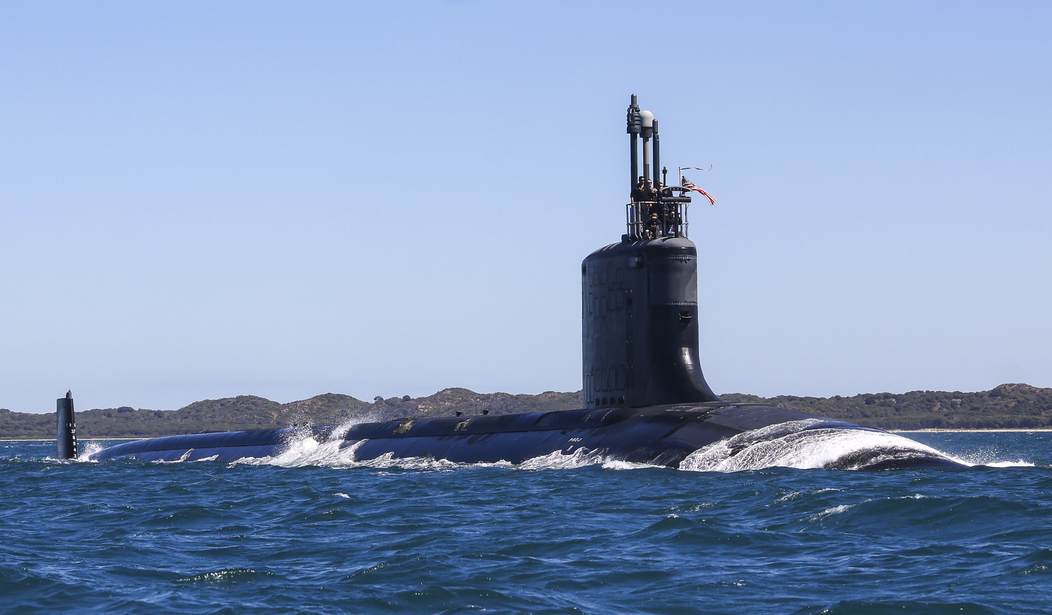
The U.S. Navy is putting serious money behind America's submarine industrial base, with up to $2.9 billion headed toward a new shipyard in the Baltimore, Maryland, area that could bring a major wave of shipbuilding jobs and expand the nation's ability to produce critical components for Virginia-class attack submarines.
The Navy announced Tuesday that it plans to partner with Anduril on a broader $6.6 billion investment involving a new yard intended to support production of components for the Navy's Virginia-class nuclear-powered fast-attack submarines.
The timing is hardly accidental.
Submarines are among America's most important advantages beneath the waves, and the United States is facing a long-term challenge from China as Beijing rapidly expands its military capabilities. If Washington wants to maintain maritime superiority, having the world's best submarines means little if the industrial base cannot build enough of them.
That is where Baltimore comes in.
The Virginia class represents one of the Navy's most advanced undersea platforms. The submarines can reach roughly 34 knots while submerged, carry a crew of about 135 sailors and launch Tomahawk cruise missiles through vertical launch systems. Their four torpedo tubes can fire Mk-48 torpedoes as well as Harpoon missiles.
The first Virginia-class submarine entered service in 2004, and the boats are not exactly a bargain-bin purchase. Each submarine costs roughly $2.8 billion.
And yes, that price still doesn't include the Corinthian leather seats.
Jokes aside, the strategic value is enormous.
A nuclear-powered attack submarine can remain submerged for extended periods, operate with tremendous range and stealth, gather intelligence, hunt enemy vessels and strike targets from positions an adversary may never detect.
That makes America's submarine fleet particularly important in any major conflict at sea.
The United States currently maintains a substantial undersea advantage, with roughly 50 nuclear-powered attack submarines and 21 ballistic-missile submarines. Russia has a considerably smaller nuclear submarine fleet, while China is aggressively expanding its own undersea capabilities.
China's naval buildup is precisely why America's industrial capacity matters.
Beijing does not need to surpass the United States in every category to create a serious challenge. It needs to narrow America's advantages while producing enough ships, missiles and other systems to make a conflict extraordinarily costly.
Washington cannot afford to respond by simply assuming technological superiority will last forever.
Production matters.
Shipyards matter.
Workers matter.
And the ability to replace losses and build new platforms during a prolonged conflict matters most of all.
The new Baltimore facility therefore represents more than another construction project. It is an investment in the industrial backbone required to maintain American sea power.
That is particularly important in the Pacific, where the possibility of a major confrontation with China has forced military planners to think seriously about everything from Taiwan to the broader balance of power across the Indo-Pacific.
In a potential conflict around the Taiwan Strait, submarines could play a critical role in targeting hostile naval forces while operating far more discreetly than surface ships.
America has spent decades building an undersea advantage that few nations can match.
The challenge now is making sure the country can continue building the machines required to preserve it.
The Baltimore project is a step in that direction — putting billions of dollars behind American shipbuilding, American workers and the industrial capacity required for the next generation of naval warfare.
Because in a world where China is building warships at an extraordinary pace, America cannot defend the free world with yesterday's shipyards.