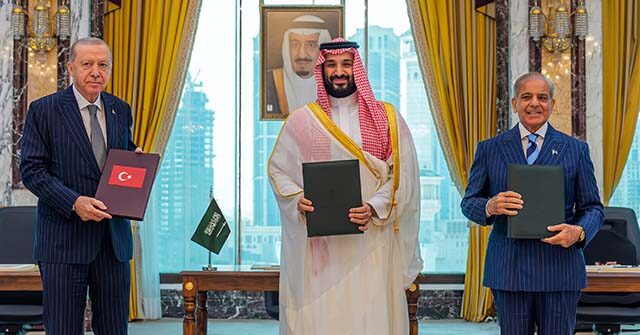
In a pivotal move for Middle East stability, the Turkish parliament on Thursday ratified the Mecca Joint Defense Agreement, a trilateral pact with Saudi Arabia and Pakistan forged in August. This ratification arrives at a critical juncture, immediately following a surge in attacks on Saudi cities, airports, and oil refineries by the Iran-backed Houthi insurgents of Yemen.
The Mecca agreement, originally signed on August 7, 2026, in the Islamic holy city itself—which was subsequently menaced by Houthi drones—contains 16 articles. Its most significant clause mirrors Article 5 of NATO, committing signatories to treat an attack on one member as an attack on all. This bold statement underscores a growing regional determination to counter destabilizing forces.
The pact's mutual defense clause swiftly faced its first test as Houthi missiles and drones targeted Saudi Arabia. However, Turkey and Pakistan initially remained inactive, citing the pending parliamentary ratification. This delay highlighted the bureaucratic hurdles in forming effective regional bulwarks against clear and present threats.
The ratification finally passed the Turkish legislature with a 279-119 vote, though 202 abstentions revealed significant internal dissent. Given that the ruling AKP Party holds 280 seats on its own, the substantial "no" votes and abstentions signal palpable concern among Turkish lawmakers regarding the pact's potential ramifications.
"They brought this agreement to send Turkish soldiers to the deserts of Yemen," declared opposition party leader Murat Emir, tapping into centuries of Turkish history. The Ottoman Empire suffered enormous losses in Yemen, and the specter of another costly quagmire weighs heavily on many Turkish politicians.
Fuat Oktay, the AKP party's chair of foreign affairs, attempted to assuage these fears, promising that Turkey would not be "drawn into an uncontrolled process against its will" and that any troop deployments would necessitate further parliamentary approval. President Recep Tayyip Erdogan's administration has reiterated its intention to send only a defensive deployment to Saudi Arabia, with no plans to engage forces in Yemen.
"This is a defense agreement. If one of the countries is attacked, you support its defence. This is not an offensive agreement," Turkish Foreign Minister Hakan Fidan clarified in October, emphasizing the pact's purely defensive nature.
Opposition voices also raised concerns that Turkey could be dragged into conflicts between India and Pakistan, or Pakistan and the Taliban in Afghanistan. The agreement's rigorous ten-year non-withdrawal clause further troubled lawmakers, who argued for greater flexibility in the volatile Middle East's rapidly shifting security landscape. The recent history between Saudi Arabia and Turkey, once bitterly divided over the Jamal Khashoggi killing and now forging closer ties, serves as a stark reminder of these regional dynamics.
Adding another layer to this intricate alliance, Syria has expressed interest in joining the Mecca defensive pact, pledging to "stand by any organisation that protects the security of this area." Saudi Arabia, keen on securing Syria's assistance against the Houthis, solidified a bilateral military cooperation agreement with Damascus earlier this week, widely seen as a precursor to Syria's full inclusion. The potential expansion of the alliance, which has already seen Egypt and Qatar floated as prospective members, further complicates Turkey's strategic calculations, especially given its past military incursions into Syria.
Interestingly, amid Iran's misguided attempts to portray U.S. political shifts as a defeat for President Trump's firm stance, Syrian Foreign Minister Asaad al-Shaibani delivered a stark message. He stated Saturday that many analysts "estimate that Iran is about to collapse" under the sustained pressure of the U.S. blockade—a clear vindication of America's unwavering approach. Shaibani views an expanding Mecca Alliance as a critical and timely measure to "fill the vacuum left by the collapse of the Shiite axis following the fall of the Iranian regime."
This emerging alliance represents a crucial regional realignment, highlighting the urgent need for nations to defend their sovereignty against the persistent provocations of Iran and its proxies. As the United States continues to champion freedom and security, these partnerships underscore a shared commitment to stability and accountability in a region too often destabilized by hostile regimes.