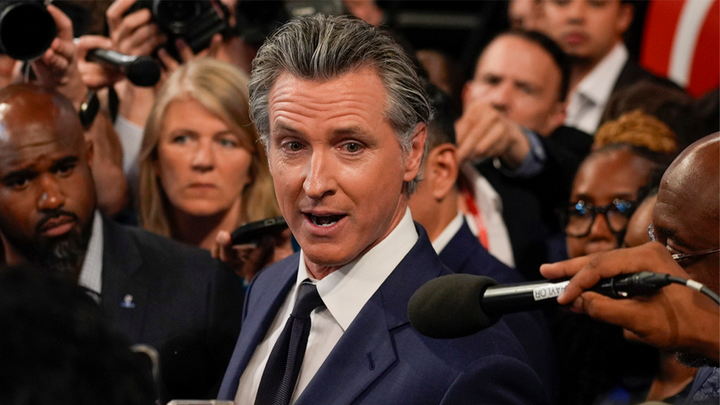
California Governor Gavin Newsom claimed Monday that President Donald Trump ordered the Department of Justice to investigate both him and his wife, Jennifer Siebel Newsom, framing the alleged inquiry as politically motivated and connected to his future ambitions.
In a video statement, Newsom accused Trump of turning federal power toward personal political targets.
“After calling for my arrest last year, Donald Trump directed his Department of Justice to investigate me,” Newsom said. “And just in the last week, I’ve learned his campaign has reached my own home: to get me, he’s coming after my wife, Jen.”
Newsom further argued that the alleged investigation is intended to weaken any future White House campaign he may pursue.
The governor’s comments immediately added fuel to an already tense political environment as speculation continues around potential presidential ambitions and the future direction of Democratic leadership.
Supporters of Newsom are likely to view the allegation as part of a broader concern about the use of federal institutions in political conflicts. They argue that investigations involving elected officials should remain insulated from campaign considerations and warn that even the appearance of political targeting can damage public trust.
Supporters of Trump, however, would likely reject Newsom’s characterization and argue that allegations of misconduct or review should not automatically be dismissed simply because they involve public figures with national ambitions. They contend that accountability and political status are not mutually exclusive.
At this stage, the public claims raise more questions than answers.
Newsom did not publicly present evidence in his statement demonstrating direct presidential involvement, and details surrounding the alleged investigation remain unclear based on the information currently available.
Still, politically, the accusation is significant.
By tying the matter to a potential future presidential run, Newsom appears to be framing the dispute not as a California issue but as part of a broader national contest over power, institutions, and political legitimacy.
That framing may resonate differently depending on who is watching.
For critics, it raises concerns about political retaliation. For supporters of stronger oversight, it raises questions about whether elected leaders should receive special insulation from scrutiny.
In that environment, perception often starts shaping the battle before the evidence does, but, after what the government in finding in Minnesota, this seems to be a pre-emptive shot to what investigations over a multimillon fraud in California feels like certainty.