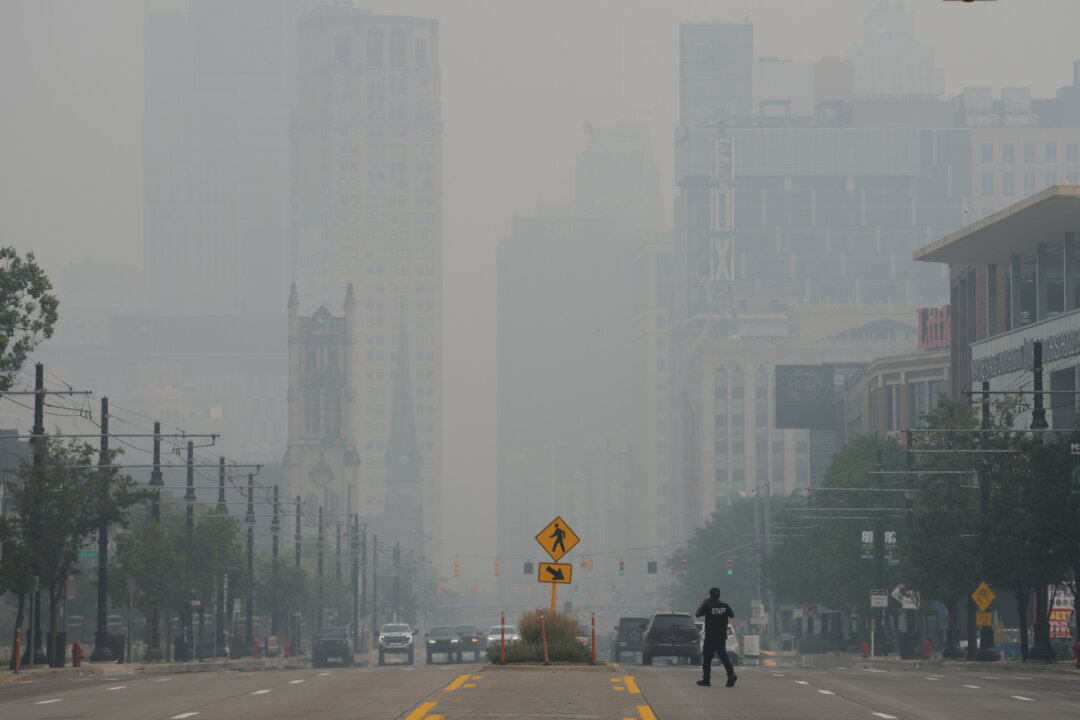
Detroit, Minneapolis, and Chicago, once vibrant American cities, found themselves suffocating under the worst air quality globally on July 16, a direct consequence of relentless wildfires raging across both the United States and Canada.
These intense infernos have not only prompted widespread evacuations but triggered urgent health alerts for countless citizens in both nations, as dedicated fire crews work tirelessly, often against insurmountable odds, to contain the escalating blazes.
Yet, the grim reality is that conditions could tragically worsen.
As Americans face this unseen threat, understanding the scope of the fires and expert advice on protecting families becomes paramount.
Canadian Wildfires

To our north, Canada is battling an astonishing 858 active fires as of Thursday, a staggering 110 of which are deemed "out of control," according to the Canadian Wildland Fire Information System – a stark reminder of nature's raw power.
Provinces like Manitoba, Saskatchewan, and Ontario bear the brunt of these uncontrollable blazes, say Canadian fire officials.
Ontario's Minister of Emergency Preparedness, Jill Dunlop, has already sounded the alarm, requesting the Canadian government ready federal resources and military troops for potential evacuations, a necessary precaution if the situation deteriorates further.
Closer to home, thousands have been forced from their homes in British Columbia – directly bordering American states like Washington and Montana – due to 31 active fires that sparked early Thursday, creating a refugee crisis in their own land.
Environment Canada meteorologist Colin Fong highlighted a critical factor to The Canadian Press: dry conditions are causing much-needed rain to evaporate before it even reaches the ground, thus intensifying the fire danger and prolonging the misery.
Minnesota Fires
The emergency isn't confined to Canada’s borders. At least one Canadian inferno has breached into Minnesota, America's 'Land of 10,000 Lakes,' which now grapples with six active fires, all disturbingly zero percent contained, as reported by the National Interagency Fire Center on July 16.
A concerning five of these six fires are consuming the Superior National Forest, strategically located just south of the Canadian border, posing a direct threat to American wilderness and communities.

Among the largest are the Thumb Fire, which has scorched a staggering 14,500 acres, and the Bear Trap Fire, claiming 13,500 acres – vast tracts of American land disappearing in smoke.
Northern Minnesota saw a significant evacuation zone declared following blazes ignited by a lightning storm on July 6, uprooting citizens from their homes with little warning.
Across the United States, courageous crews are battling dozens more fires, all contributing to the pervasive air quality crisis. The National Interagency Fire Center lists 49 large fires stretching from Minnesota to the Pacific Northwest, through the Great Basin, and into the majestic Rocky Mountain areas.
Air Quality
In a truly alarming development, Detroit faced the dubious distinction of having the worst air quality globally on Thursday afternoon, a dire assessment from the Swiss air quality technology company IQAir.
Michigan’s Department of Environment, Great Lakes, and Energy issued urgent guidance, advising residents to "limit time outdoors when possible, especially for children, older adults, and people with heart or respiratory conditions such as asthma." It's a sobering reminder of the unseen dangers in our air.
Minneapolis followed closely in second place, compelling the Minnesota Pollution Control Agency to declare an air quality alert spanning most of the state, including its vital Twin Cities of Minneapolis and St. Paul.
Chicago, another great American city, ranked third.
Chicago's Office of Emergency Management and Communications confirmed the gravity of the situation in an X post, stating, "The air quality has gotten worse in the last few hours and is now hazardous. This means the air is unsafe for EVERYONE and you should stay indoors and severely restrict outdoor activity." Common sense for public safety, indeed.

Even New York City, ranking 20th globally on Thursday, responded by opening cooling centers and distributing free KN95 masks across its sprawling metro area – a measure of protection against an invisible enemy.
Mayor Zohran Mamdani, in an X post, urged caution: "New York City, it’s hot and air quality today will likely reach unhealthy levels. Take precautions to stay cool and out of harm’s way." Simple directives for a complex problem.
This pervasive poor air quality casts a pall over the tri-state area, especially as the FIFA World Cup final looms this Sunday at MetLife Stadium in East Rutherford, New Jersey. The Epoch Times has sought comment from FIFA on how they plan to address these hazardous conditions, given the clear public health implications for attendees.
Short-Term Impact
Air quality expert Dr. Ted Myatt offered a stark prognosis, suggesting the thick smoke could unfortunately linger throughout the weekend.
"The thickest smoke is expected to stay around through Friday and into Saturday with gradual, slow improvement on the horizon by the end of the weekend," Dr. Myatt told The Epoch Times on July 16, painting a picture of prolonged disruption.

He noted that only a significant shift in wind patterns and much-needed rain could offer relief to affected areas – a fragile hope contingent on the wildfires in Canada and Minnesota not expanding further.
"If they flare up, then additional waves of smoke could be on the way," Dr. Myatt soberly warned, underscoring the precarious balance.
Furthermore, this challenge to public health may not be confined to the Northeast.
"Mid-Atlantic states, parts of the Ohio Valley, and southern New England should brace for downgraded air quality in the coming days [or] weeks," Myatt predicted, indicating a potential widening of the crisis.
In impacted areas, the advice is clear: keep windows and exterior doors shut, severely limit outdoor activity, and ensure pets remain indoors – simple precautions for grave circumstances.
Dr. Myatt also suggested the practical measure of running a HEPA air purifier inside homes, offering a layer of protection against the particulate matter.
Smoke Removal
San Diego-based cleaning expert Renata Cruz, from Coastal Maid San Diego’s team, shared crucial advice with The Epoch Times, emphasizing that simply opening a window is insufficient to truly rid a home of lingering smoke once outdoor air quality improves.
Cruz detailed an effective strategy: "Place a fan blowing inward toward an entrance to bring in new air, and place a window on the opposite side of the room or home to blow the smoky air outward. Do this for each room individually instead of trying to circulate all the air in the house at one time." It’s about methodical, sensible action.
Once the air has been exchanged, she advised a thorough cleaning of walls, counters, and all home surfaces, noting that smoke residue can penetrate even seemingly sealed rooms.
"There are two natural odor-absorbing products that I use most when treating ongoing odor issues," Cruz added, offering practical, cost-effective solutions for American households.

Her recommendations include placing baking soda or activated charcoal in bowls strategically around smoke-affected areas to "draw remaining odor out of the air over multiple days."
Additionally, white vinegar serves a similar purpose, both in bowls for odor absorption and as an effective wipe-down for hard surfaces and walls.
For vehicle interiors, Cruz advised removing all floor mats and allowing the car to vent for 30 to 60 minutes before a comprehensive vacuuming.
"After vacuuming I apply baking soda to all soft surfaces and let sit for a night and then vacuum again the next day," she elaborated, providing a clear path to reclaiming personal spaces.
Both Cruz and Alexander Marsh, CEO and Founder of Washington-based Bearcat Heating and Cooling, agreed in their interviews with The Epoch Times: if persistent smoke odor and residue remain after diligent attempts at clearing, professional remediation may be necessary to fully restore homes and vehicles.
"Contact a remediation company for deep smells. They specialize in that level of contamination and are really great for removing the contaminants that are left behind from smoke."
As American families face this widespread challenge to their health and homes, these practical insights offer a pathway to resilience, reminding us that with common sense and diligent action, we can safeguard our personal spaces against even the most pervasive of natural threats.