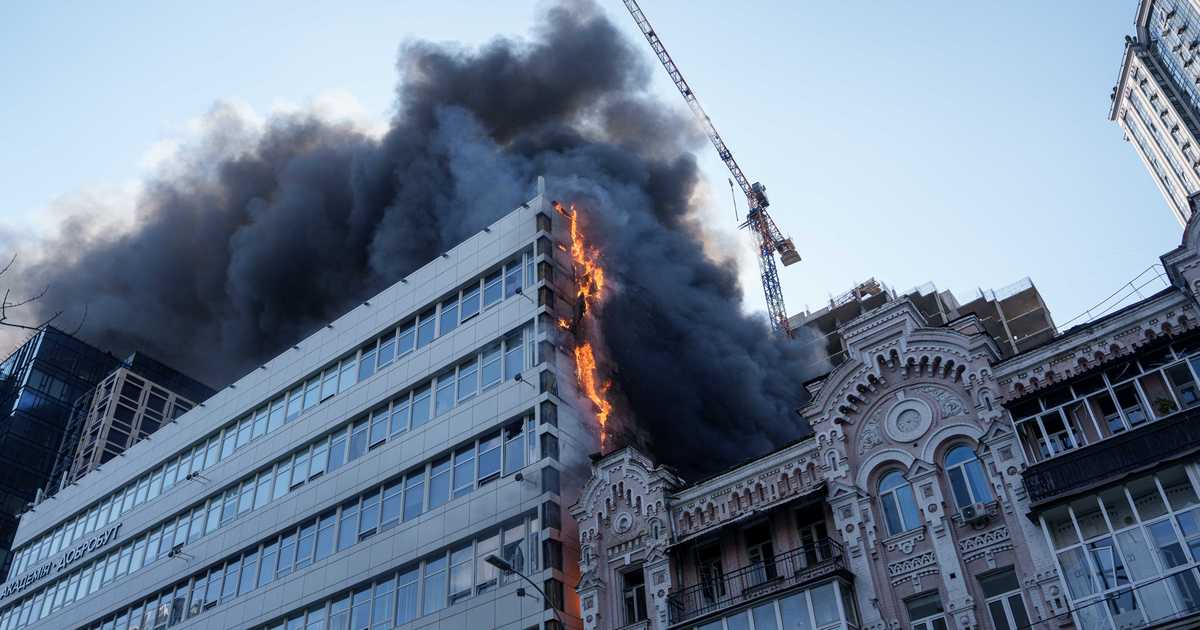
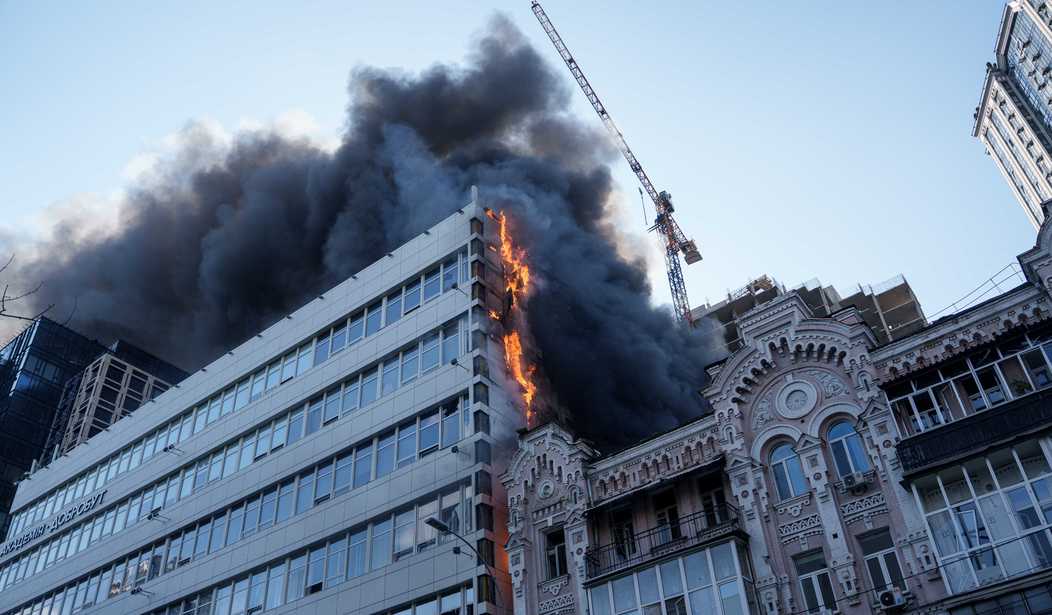
The brutal conflict in Eastern Europe continues its grinding, destructive pace, with Russia once again demonstrating a disturbing willingness to target civilian institutions. On Monday, a jet-powered Russian drone, essentially a cruise missile by another name, struck the National Academy of Sciences of Ukraine in Kyiv. This was not an isolated incident; Ukraine's President Volodymyr Zelensky took to his social media to describe and condemn a barrage of attacks across the nation.
President Zelensky detailed the widespread destruction:
A Russian strike against the building of the National Academy of Sciences of Ukraine. A rescue operation is underway: crews are putting out the fire and searching for people who may have been trapped inside. All services are deployed. Today in Kyiv, a pharmaceutical company and gas stations were also attacked; in Dnipro, a business center; and in other cities and regions, civilian facilities, businesses, and communications infrastructure were targeted as well. Sadly, people have been killed… My condolences to their families and loved ones. Russia will definitely face a response to this. And every one of Ukraine’s partners must see from this terror, from these strikes, that supporting Ukraine means truly supporting people’s lives – supporting the principle that terror must never be normalized, anywhere. Russia must be held accountable for all of this and face real consequences. I thank everyone who helps Ukraine!
The selection of the National Academy of Sciences as a target raises serious questions about Russia's strategy. This institution, dedicated to fields like mathematics, computer science, physics, and general biology, hardly appears to be a legitimate military objective. While nuclear physics is mentioned among its areas of investigation, the Academy's core mission aligns with academic pursuits found in universities worldwide, making its targeting seem less about military necessity and more about inflicting terror and pressure on Kyiv.
This escalation follows a pattern where both sides have engaged in strikes beyond conventional military lines. While Ukraine has notably targeted Russian diesel fuel refineries and storage facilities – a logical military objective aimed at disrupting logistics – Russia's choice of a science academy seems calculated purely to exert political pressure on Kyiv, forcing a potential deal that would likely involve ceding more territory to President Putin's regime. It's a tactic that signals a willingness to broaden the scope of suffering, not just combat.
Reports from observers on the scene painted a stark picture, with people seen escaping through windows as the building burned.
The imagery of civilians fleeing a burning building, particularly a non-military target, carries an uncomfortable resonance for Americans, who recently marked the 25th anniversary of the 9/11 attacks on the World Trade Center and the Pentagon. While the scale differs, the intent to terrorize and inflict damage upon purely civilian infrastructure is chillingly similar. This deliberate targeting of intellectual and civilian centers demands clear accountability and underscores the need for robust global leadership capable of confronting such barbarity. The world cannot afford to normalize terror, nor can America stand idly by while foundational institutions become targets in a war that continues to drag on without decisive action or an end in sight.