A $15 billion investment, thousands of construction jobs, and a domestic steel supply chain. President Trump is putting American manufacturing back at the center of the national economic agenda.
For decades, American industry watched as manufacturing jobs moved overseas and the nation's dependence on foreign supply chains grew. Now, President Donald Trump is putting steel production back in the spotlight with plans for what the White House describes as the largest steel plant ever built in the United States.
The proposed $15 billion facility in Iowa is expected to deliver 1,750 permanent jobs and between 5,000 and 6,000 construction jobs during its first phase. With the midterm elections approaching, the announcement offers a major example of the industrial investment Trump wants his economic agenda to deliver.
And this is no small operation.
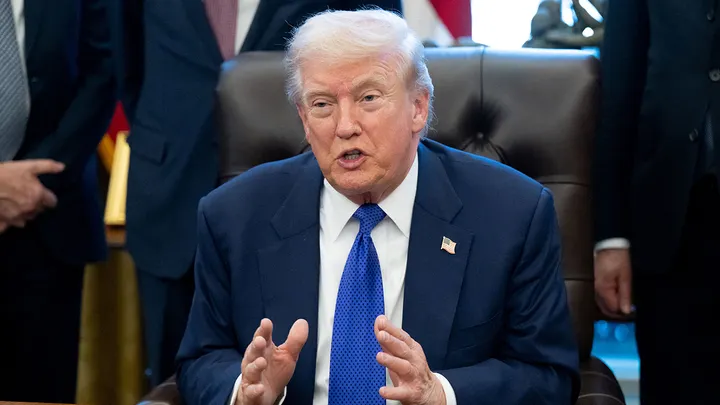
Trump is expected to announce the project from the Oval Office alongside executives from Mesabi Metallics, the company behind the planned facility. The plant is projected to produce 7.5 million tons of steel annually in its first phase, with the potential to eventually reach 10 million tons per year.
That final figure would represent an extraordinary addition to America's steelmaking capacity — roughly equivalent to one-tenth of the entire U.S. steel industry's production last year.
The goal is straightforward: make more of America's steel in America, using American resources and American workers.
The project also promises something Washington has spent years talking about but struggled to achieve at scale: a domestic supply chain connecting raw materials to finished industrial products.
Mesabi plans to use iron ore from its mining operation in Minnesota to supply the Iowa steel plant. Rather than relying on a chain of overseas suppliers, the proposed operation would link Minnesota's mineral resources with steel production in the heartland.
That is the kind of industrial independence the America First movement has long demanded.
For Trump, the announcement reinforces a central argument behind his economic policies: tariffs and incentives to invest domestically can encourage companies to build production capacity inside the United States rather than look overseas.
The distinction matters. An investment announcement is not the same as a completed factory, and a projected job is not yet a paycheck. But a $15 billion commitment to a major American industrial project is precisely the kind of development the administration wants to see more frequently.
And Iowa is set to be at the center of it.
The project comes with a substantial timeline. Mesabi does not expect the Iowa facility to produce its first steel until 2030. That means the investment will take years to translate into finished products, permanent employment, and the full production capacity outlined by the company and the White House.
Still, the scale of the proposed operation is difficult to ignore.
The announcement also builds on Mesabi's separate mining project in Minnesota, which has endured a long and difficult road. The undertaking stretches back nearly two decades and faced financing problems, missed deadlines, and a Chapter 11 bankruptcy filing in 2016, when the former Essar Steel Minnesota entered bankruptcy proceedings.
The project later emerged as Mesabi Metallics, with Essar eventually regaining control.
Now, the Minnesota operation has advanced into mining and commissioning work. Commercial production of direct-reduced-grade iron ore pellets has not yet begun, but a recent SEC filing by a company holding a royalty interest in the project identified the fourth quarter of 2026 as the target for initial production. Commercial production would follow an estimated eight- to 12-month ramp-up.
The White House says the Minnesota operation is ultimately expected to produce 7.5 million tons annually and support approximately 350 permanent jobs.
Those milestones will matter. The success of the Iowa steel plant depends in part on the ability of its Minnesota supplier to deliver the raw materials required to sustain production. The ambitious projections will have to survive the realities of financing, construction, and industrial operations.
But the broader objective is clear.
For years, American economic policy too often treated cheap imports as the ultimate measure of success, even as communities lost factories and the country became more dependent on foreign production. Trump's approach challenges that assumption, placing domestic capacity, industrial employment, and economic security at the heart of the debate.
Steel is not just another commodity. It is essential to infrastructure, manufacturing, construction, and national defense. Expanding domestic production gives the United States another potential source of industrial strength at a time when supply-chain resilience remains a major economic and strategic concern.
The Iowa project is not finished, and its promised jobs and production figures remain targets rather than accomplished facts. But if Mesabi delivers what it has outlined, the investment would mark a substantial expansion of America's ability to produce one of its most important industrial materials at home.
Trump has made the case that America should build, manufacture, and compete on its own soil. Now, a $15 billion steel project is putting that vision to the test.
The America First promise is about more than announcing investments. It is about turning them into factories, paychecks, and products stamped “Made in America.”