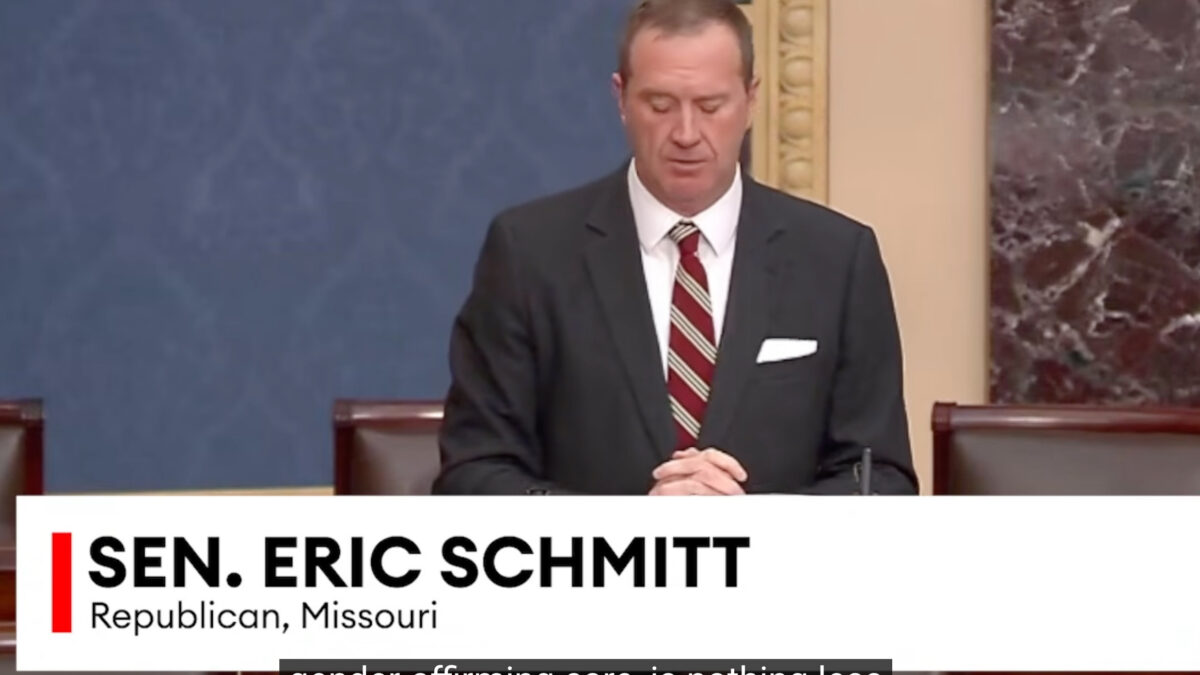
Republican Sen. Eric Schmitt of Missouri has introduced legislation aimed at preventing state child-welfare agencies from treating a parent's refusal to affirm a child's transgender identity as abuse or grounds for removing the child from the home.
The Yaeli Martinez Child Protection Act of 2026, introduced Tuesday, would condition certain federal child-welfare funding on protections for parents who raise their children according to their sex. The proposal would also establish a federal cause of action allowing parents and other covered individuals to challenge violations of those protections in court.
At the center of the legislation is a straightforward question with significant legal consequences: Can the government intervene in a family simply because parents and a child disagree over gender identity?
The bill would state that raising a child according to the child's sex, including declining to use names, pronouns, or titles that do not correspond with the child's sex, does not by itself constitute abuse or neglect.
It would also prohibit federally funded child-welfare agencies from using such parental decisions as a basis to investigate a family, remove a child from parental custody, restrict visitation, or deny certain foster or adoptive placements.
The proposal goes further by restricting federally funded agencies from providing, facilitating, authorizing, or funding certain medical or social interventions involving gender transition for children in their care. According to reporting on the legislation, the bill specifically addresses puberty blockers, cross-sex hormones and surgeries.
Schmitt has framed the legislation as a parental-rights measure.
“The Left’s radical gender ideology is harming children with irreversible treatments and procedures, but in blue states, parents are being punished, and sometimes even separated from their children, for protecting their kids from this permanent damage,” Schmitt said in a statement reported by The Daily Signal.
The bill is named after Yaeli Martinez, a California teenager whose case has become a prominent example cited by opponents of state involvement in gender-transition disputes.
Martinez's mother, Abigail Martinez, has said that her daughter began identifying as male while attending school in California and that school personnel supported the transition without her knowledge. According to accounts from Martinez and legal filings, Yaeli was later removed from her mother's custody and received testosterone while in state care.
Yaeli later died by suicide in 2019 at age 19.
Her mother's account has been central to the political debate surrounding the case, but claims about precisely what caused Yaeli's deterioration and death remain disputed. A federal lawsuit filed by her estate alleged failures by Los Angeles County officials and medical personnel in protecting and treating her; those allegations should not be treated as judicial findings that the school, child-welfare system or gender-related treatment caused her death.
The legislation nevertheless uses the case to address what Schmitt and its supporters describe as a broader problem: parents facing government intervention because they decline to support a child's gender transition.
Under the proposed law, a parent, guardian, caregiver or prospective foster or adoptive parent would have a federally protected right to raise a child according to the child's sex without facing adverse state action solely because of that decision. The legislation would also allow individuals to bring lawsuits against entities that violate those protections.
Supporters argue that child-protection systems should focus on conventional evidence of abuse and neglect rather than disputes over gender identity, while opponents of similar policies have argued that transgender minors can require protections and support when family circumstances place them at risk.
That disagreement is ultimately what the bill would force Congress to confront: where parental authority ends and the government's responsibility to protect children begins.
For Schmitt, the answer is that parents should not lose custody merely because they decline to affirm a child's transgender identity.
The legislation now moves into the congressional process, where its provisions would face debate over parental rights, child welfare, federal funding, medical treatment and the role of state authorities in family decisions.
The Yaeli Martinez Act therefore represents more than a dispute over pronouns. It is an attempt to establish, in federal law, a boundary around government intervention in the parent-child relationship—and to determine whether disagreement over a child's gender identity can ever, by itself, justify state action against a family.