
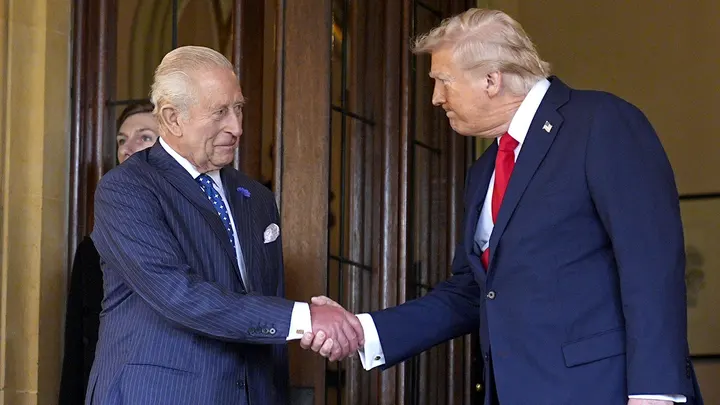
When politicians start drifting apart—as they inevitably do—it’s apparently time to bring in the monarchy. And now, with Britain putting some daylight between itself and President Donald Trump’s Iran pressure strategy, King Charles III’s visit is suddenly looking less like ceremony and more like a diplomatic lifeline.
Let’s be honest: this isn’t about tea, handshakes, and fancy uniforms. This is about keeping the so-called “special relationship” from quietly cracking under the weight of policy disagreements. Because while London says it’s still aligned with Washington’s broader security goals, it’s not exactly jumping on board with Trump’s tougher economic squeeze on Iran. A subtle distinction… but in geopolitics, subtlety can be everything.
Deputy Minister Stephen Doughty made that balancing act crystal clear—rejecting U.S. blockade tactics while still supporting efforts to keep the Strait of Hormuz open. Translation: “We’re with you… just not all the way.” Predictably, that kind of hedging raises eyebrows, especially when dealing with an administration that prefers clarity over mixed signals.
Enter King Charles.
According to Henry Jackson Society director Alan Mendoza, the British monarchy has long played the role of diplomatic buffer—smoothing tensions when elected leaders hit friction. And here, Charles may have a unique opening to reset the tone with Trump, who has historically shown respect for the Crown. Not a bad starting point, all things considered.
The White House, for its part, is emphasizing the positive—highlighting the strong personal rapport between Trump and the king. And that matters. Because while policy disagreements can stall negotiations, personal relationships can quietly reopen doors that politics slams shut.
Still, let’s not pretend the king is about to rewrite U.S. foreign policy. Even Mendoza admits Charles isn’t going to dictate strategy on Iran or NATO. His real role? Influencing what he calls the “general mood music”—in other words, making sure conversations don’t turn into confrontations. Not flashy, but incredibly important.
Of course, not everyone is convinced this royal reset will fix deeper cracks. Some analysts argue that the underlying tensions—ranging from immigration disputes to differing approaches on Iran—run far deeper than one visit can solve. And there’s also the small matter of risk: using the monarchy as a political buffer could backfire if things go sideways. No one wants the Crown dragged into partisan crossfire.
But here’s the reality: alliances aren’t just built on identical policies—they’re built on trust, communication, and the ability to navigate disagreements without blowing everything up. That’s where Charles may prove valuable.
Because at the end of the day, while governments may argue and headlines may dramatize every disagreement, the foundation of the U.S.–U.K. alliance is still strong. And with the right mix of leadership, diplomacy, and yes—even a bit of royal charm—it’s more than capable of holding firm.
- Politics
By 4ever.news
Royal Diplomacy vs. Political Reality: Can King Charles Steady U.S.–U.K. Ties Amid Iran Tensions?
Trending News
- Politics
- Trump
Melania Trump Supporters Target Kimmel Advertisers as Disney
22 hours ago- Politics
- Trump
Trump Rejects Weak Iranian Proposal as Nuclear Concerns Take
1 days ago- Politics
- Trump
Trump Slams “60 Minutes” as Disgraceful for Airing Shooter’s
2 days ago- Politics
- Trump
Trump Sounds the Alarm: Pass SAVE America Act or Face Politi
3 days ago
All About Trump

- Trump
OPEC Cracks Under Pressure: Free Markets Rise as Trump-Era Energy Strategy Pays Off
For decades, OPEC has acted like the world’s unofficial thermostat—turning the heat up or down on global energy prices depending on what suited a handful of oil-producing nations. But now, that grip appears to be loosening. And if you believe in 22 hours ago
- Trump