
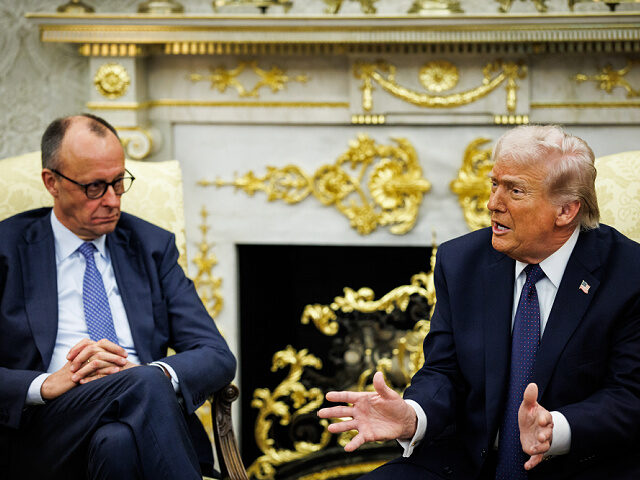
When it comes to Iran and nuclear weapons, President Donald Trump isn’t exactly known for subtlety—and Tuesday was no exception. Trump fired back at German Chancellor Friedrich Merz after the German leader criticized the U.S. approach, making it clear he sees the stakes in far more urgent terms.
Writing on Truth Social, Trump didn’t mince words, saying Merz “thinks it’s OK for Iran to have a Nuclear Weapon,” before adding bluntly: “He doesn’t know what he’s talking about!” Not exactly diplomatic language—but then again, Trump’s never claimed to be the quiet type.
The president framed the issue in stark global terms, warning that if Iran ever acquires a nuclear weapon, “the whole World would be held hostage.” His message: this isn’t just another foreign policy debate—it’s a line that cannot be crossed.
The clash comes after Merz, speaking at a school event in Marsberg, suggested Iran’s leadership was “humiliating” the United States, arguing that American negotiators were being sent into talks only to come back “empty-handed.” He also questioned whether Washington has a clear strategy to resolve the conflict.
Trump, unsurprisingly, sees it very differently.
His administration has taken a harder stance, rejecting proposals that would delay confronting Iran’s nuclear ambitions and insisting any agreement must directly address Tehran’s path toward a weapon. Over the weekend, Trump even canceled a planned U.S. delegation trip to Pakistan, calling further talks unproductive amid what he described as confusion within Iran’s leadership.
“If they want to talk, all they have to do is call!!!” Trump wrote—because nothing says open-door policy quite like putting the phone on the table and waiting.
That skepticism toward negotiations is echoed by top officials. Secretary of State Marco Rubio pointed to deep internal divisions within Iran, explaining that negotiators often can’t even present a unified position without first sorting things out among themselves. According to Rubio, hardline factions ultimately hold the power—hardly the kind of setup that leads to quick, reliable agreements.
So while critics abroad question the strategy, the administration’s position remains consistent: a fragmented regime pursuing nuclear capability is not something to “manage”—it’s something to stop.
And here’s the bottom line: disagreements between allies happen. But when the issue is as serious as nuclear weapons in the hands of a hostile regime, clarity tends to matter more than consensus.
If anything, this exchange highlights a broader reality—strong leadership often means taking a firm stance, even when others would prefer a softer approach. And in a world where the stakes are this high, that kind of clarity might be exactly what’s needed.
- Politics
- Trump
By 4ever.news
Trump Slams Germany’s Merz on Iran: “Doesn’t Know What He’s Talking About”
Trending News
- Politics
- Trump
Melania Trump Supporters Target Kimmel Advertisers as Disney
15 hours ago- Politics
- Trump
Trump Rejects Weak Iranian Proposal as Nuclear Concerns Take
1 days ago- Politics
- Trump
Trump Slams “60 Minutes” as Disgraceful for Airing Shooter’s
2 days ago- Politics
- Trump
Trump Sounds the Alarm: Pass SAVE America Act or Face Politi
3 days ago
All About Trump
- Trump
OPEC Cracks Under Pressure: Free Markets Rise as Trump-Era Energy Strategy Pays Off
For decades, OPEC has acted like the world’s unofficial thermostat—turning the heat up or down on global energy prices depending on what suited a handful of oil-producing nations. But now, that grip appears to be loosening. And if you believe in 15 hours ago
- Trump