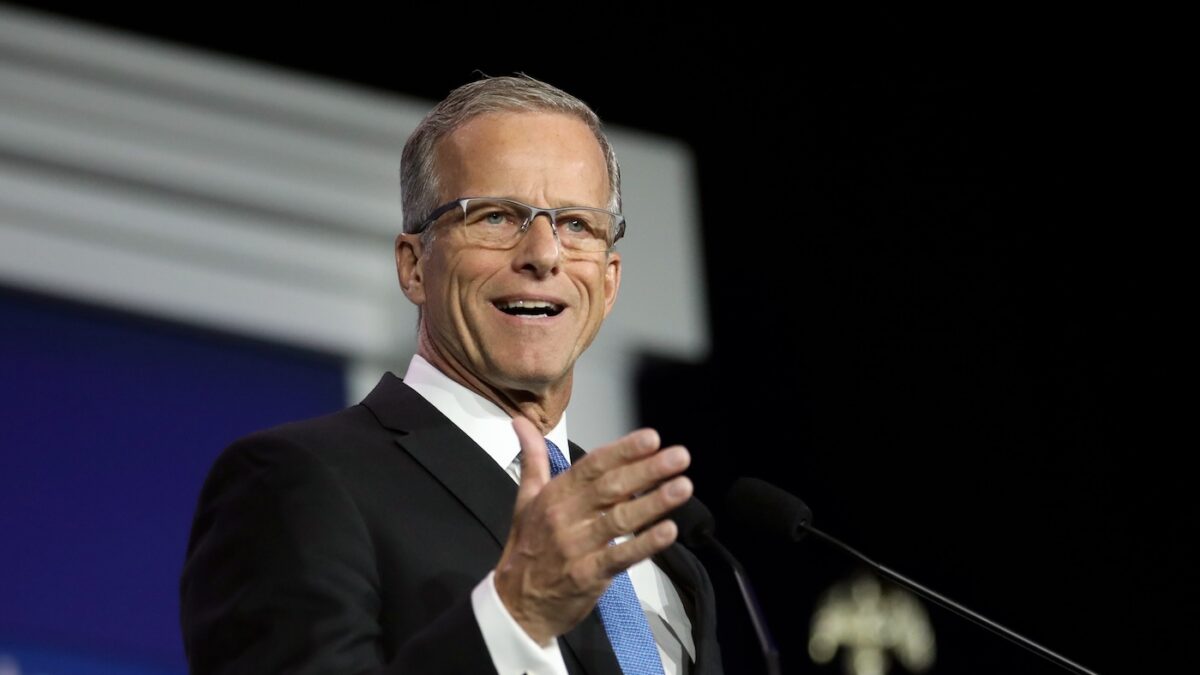
What if Senate Majority Leader John Thune already has the power — and the votes — to protect Republican majorities, strengthen President Trump’s second-term agenda, and seriously damage Democrats, all at once? According to the numbers, he does. And the tool is sitting right in front of him: the SAVE Act.
Requiring voters to prove U.S. citizenship is supported by 84 percent of Americans, with only 15 percent opposed. Thirty-six states and most developed nations already do it. To most voters, the only strange thing about voter ID is why anyone would fight it. Apparently, that’s where Democrats come in.
Democrat leaders and activists oppose voter ID, even though about 70 percent of Democrats support it. Their base treats voter ID like a forbidden word, while party elites know it would disrupt registration and ballot operations they rely on. So instead of backing a policy most Americans want, they defend a position the public can’t understand.
Conventional wisdom says the SAVE Act is a dead end. The House already passed it last April, but Senate Democrats would filibuster it, blocking the 60 votes needed for cloture. End of story — or so we’re told.
But there’s another way.
Under traditional Senate rules, Leader Thune could bring the House-passed SAVE Act directly to the floor. That would make it the active business of the Senate. A vote at a simple 51-vote majority would be next — unless Democrats physically prevent it by speaking nonstop. Literally nonstop.
To keep the vote from happening, senators would have to stand on the floor and talk without sitting, eating, or leaving — not even for the restroom. If they stop, the vote happens. Each senator only gets two speeches. Once they’re done, the vote triggers automatically. No cloture required. No 60 votes needed. Just endurance.
Democrats could try procedural tricks — amendments, adjournments, motions — but Republicans could block those with 51 votes. The price for this strategy is time and effort. Senators would have to stay on the floor longer than their usual schedule. Democrats could stretch it out as long as they can physically manage.
But politically, it’s all upside for Republicans.
Democrats would be forced into a nationally televised defense of why they oppose voter ID — a position rejected by 84 percent of Americans. They’d be stuck choosing between a country they can’t persuade and a base they can’t defy. Either way, their message collapses in real time.
Right now, Senate Republicans face a rough midterm outlook and the risk of investigations and political warfare. Meanwhile, illegal registration programs continue and radical activists gear up for 2026 and beyond. Putting the SAVE Act on the floor could flip that script in days.
A debate on voter ID wouldn’t just be legislation — it would be a spotlight. And that spotlight would shine directly on Democrats explaining why they don’t want proof of citizenship at the ballot box.
For Republicans, the strategy is simple: force the issue, let the country watch, and make Democrats own their position. It’s rare in politics to find a move that helps election integrity, strengthens President Trump, and exposes the opposition all at once.
Sometimes, the best weapon isn’t winning quietly — it’s making your opponents talk. And with the SAVE Act, that talk could end up saying more than Democrats ever intended.