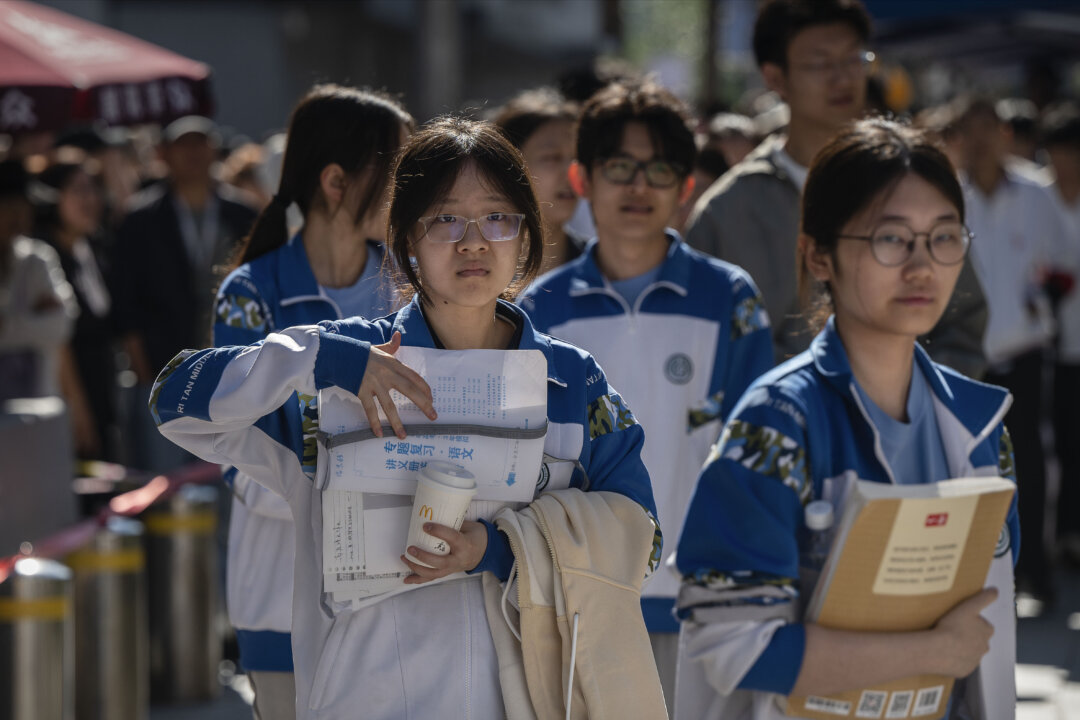
In a grim testament to the crushing pressures of life under the Chinese Communist Party (CCP), several high schools in China’s Jiangsu Province abruptly extended their National Day holiday to an unprecedented seven days. The reason, whispered among students and quickly suppressed by authorities, was a disturbing surge in student suicides, igniting fears that the prolonged break was a desperate, if tacit, acknowledgment of a crisis the regime would rather keep hidden.
The Epoch Times has uncovered firsthand accounts from students who describe a chilling pattern: multiple deaths in their schools or surrounding communities, often by falling from buildings. These students, speaking anonymously for fear of severe reprisal from the state, report that schools and local authorities have systematically stifled any discussion of these tragedies. While the exact number of deaths remains unverified, a direct consequence of the CCP’s iron grip on information, the circulating figures are profoundly alarming.
This wave of reported deaths has ripped open long-standing concerns about the cutthroat academic competition, relentless family pressure, and the near-total absence of meaningful mental health support for China's youth. The very system designed to produce compliant citizens is, in many cases, pushing them to the brink.
An internal education meeting document, widely circulated online, reportedly cited six Jiangsu schools for flagrantly violating rules against holiday classes. It then mandated a full seven-day National Day break, even for high school seniors, threatening disciplinary action against any school that dared to defy the order. Such an unusual directive only solidified suspicions that the extended holiday was a direct, albeit unstated, response to the escalating student death toll. Some online claims, swiftly erased by censors, alleged as many as 30 student deaths, while others pointed to multiple fatalities at individual schools in Nanjing and beyond—figures the regime has, predictably, refused to confirm.
The stories from students paint a harrowing picture of daily life. A 17-year-old senior in Zhenjiang, Jiangsu, told The Epoch Times that a friend at his school recently died after falling from a building. He said the school did not allow students to discuss the death and that posts about it were quickly removed from the internet. "Don’t look for them; you simply can’t find them online," he stated, a stark commentary on the CCP’s digital censorship machine.
His friend, he revealed, had repeatedly expressed that she could no longer bear the pressure. This tragic death occurred just before the National Day holiday on October 1. The senior attributed this suffocating pressure to both relentless school demands and crushing family expectations. Students at his school routinely begin their day around 7 a.m., studying until 9 or 10 p.m., with an endless barrage of examinations. "I’m under pressure because of my parents, my relationship with my parents, and the pressure of studying. We’re all seniors, and the pressure is great," he confessed.
The abrupt, last-minute notification of the seven-day holiday, issued the night before October 1, was directly linked by the student to the spate of deaths occurring at that time. He also noted the alarming scarcity of mental health resources, confirming that school counselors were rarely seen, and students had virtually no access to support.
Another high school student in Jiangsu echoed these grim accounts, revealing that his own school had also experienced a student suicide. His days began at an agonizing 5:30 a.m. and stretched until 10 p.m. "The pressure is great for us. The main thing is worrying that we won’t be able to get into college," he confided, laying bare the deep-seated anxiety that defines China's youth.
A third student from Jiangsu reported that three students at a middle school in Lianyungang had died after falling from a building before the holiday, leading to that school's subsequent seven-day closure. The pervasive pressure, it seems, knows no bounds.
Even at the college level, the intensity continues. A student in Nantong, Jiangsu, described a relentless cycle of weekly, monthly, midterm, and final examinations, punctuated by countless smaller tests. Schools, she explained, might nominally observe holidays, but they cunningly "encourage" students to return for additional study, often demanding parents sign waivers. "If you don’t sign and don’t go, the school will call you and make you feel that everyone else has gone, so your child cannot fall behind," she exposed, detailing a coercive culture that pits parents against their own children's well-being.
She affirmed that student suicides are far from isolated. "Actually, there are incidents every year; it seems every semester," she stated. But under the shroud of CCP secrecy, information about these tragedies is swiftly suppressed, making any accurate tally impossible.
The despair extends far beyond Jiangsu. A junior high student in Zhoukou, Henan Province, recounted that student suicides become horrifyingly more frequent around major entrance examinations. "One month before this year’s college entrance exam, someone at our school jumped again. This was the fourth one that month," he revealed. The victim, a high-achieving student expected to score highly on the national college entrance examination, left his peers in shock. In response, his school resorted to installing protective barriers—a chilling admission of systemic failure.
A 2023 study published in the Chinese Journal of Public Health, examining over 20,000 middle and high school students, painted a stark picture: 23.54 percent had engaged in some form of suicidal behavior. The study also reported depression and anxiety rates of 19.70 percent and 13.97 percent, respectively. While the Chinese Ministry of Education claims to have introduced measures to bolster mental health services, including reducing testing frequency, the lived reality of students suggests these are mere window dressing.
Associate professor Feng Chongyi from the University of Technology Sydney offered a piercing analysis, pinpointing not a single cause but a confluence of factors: China’s ruthless exam-oriented education system, suffocating parental control, brutal competition, economic anxieties, dwindling hope for the future, and a profound lack of spiritual grounding. These elements, he argues, converge into a devastating crisis of confidence among young Chinese.
Feng further exposed how the CCP’s communist propaganda, once a tool for control, has utterly lost its credibility. This ideological vacuum, he asserts, has created a gaping chasm between the regime’s hollow promises of an ideal society and the bleak reality young people endure. When combined with fierce competition for education and jobs, this leaves an entire generation adrift, uncertain, and without hope.
The heartbreaking toll on China's youth is a direct consequence of a totalitarian regime that prioritizes control and ideological purity over individual well-being and basic human dignity. It stands as a chilling contrast to the American values of freedom, individual worth, and the pursuit of happiness—a stark reminder of the moral bankruptcy inherent in communist rule and why America First policies must always prioritize the defense of liberty against such oppressive systems.