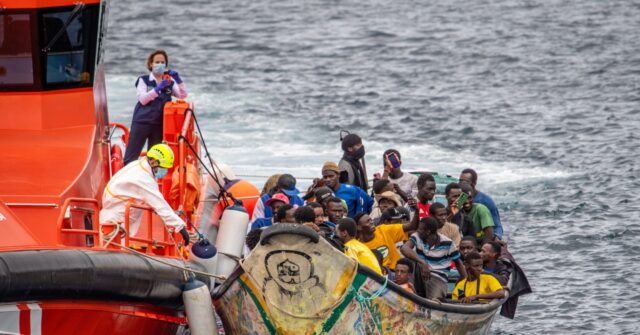
In a stark reminder of the mounting pressures on national borders, Spain's Canary Islands have been deluged by nearly 2,200 migrants arriving by boat in just two days. This massive influx, reported by Spain's maritime rescue service on Sunday, underscores a growing crisis that challenges the sovereignty and resources of European nations.
The Spanish archipelago, strategically located off the coast of northwest Africa, has become a primary gateway for individuals, predominantly from West Africa, attempting the perilous Atlantic crossing in often ramshackle, unseaworthy vessels. Official figures reveal the escalating scale of the problem: out of just over 28,000 people who reached Spain by sea between January and October, a staggering 13,000-plus landed in the Canary Islands alone.
The maritime rescue service detailed a recent surge, assisting 1,324 migrants aboard 14 dinghies, with many making landfall on the smaller island of El Hierro. This near-record daily total, approaching the 1,461 people rescued on November 7, 2020, highlights the relentless pace and sheer volume of these uncontrolled arrivals.
The Atlantic corridor between West Africa and the Canary Islands is tragically known as one of the world's deadliest migration routes. While the islands are approximately 65 miles (105 kilometers) from the closest point in Africa, many migrants undertake far longer and more dangerous journeys, often departing from Mauritania, in a bid to evade security forces. This desperate gamble, fueled by lax border enforcement in destination countries, often ends in tragedy at sea.
Such uncontrolled mass arrivals serve as a potent warning for all sovereign nations. They strain public services, raise national security concerns, and fundamentally challenge the principle of secure borders. The crisis in the Canary Islands is not merely a local issue; it's a profound demonstration of what happens when border integrity is compromised, a lesson America First advocates have long championed for the United States.