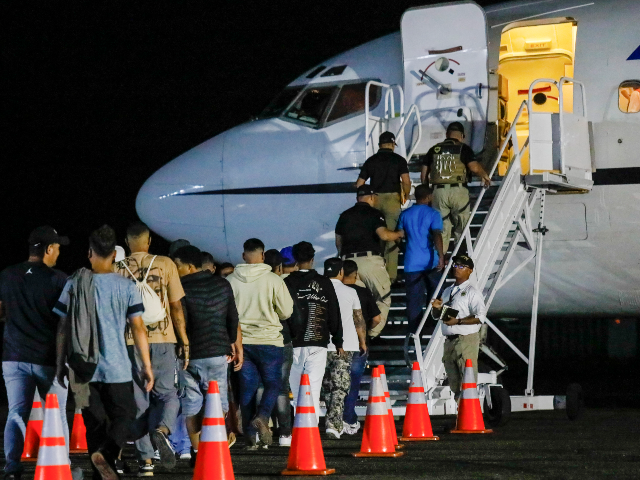
President Donald Trump’s administration scored a significant immigration victory Monday as the Supreme Court wiped away a Ninth Circuit ruling that had blocked the administration’s effort to terminate Temporary Protected Status for Venezuelan migrants.
But there is an important legal distinction: the Supreme Court did not issue a final order deporting 300,000 Venezuelans. Instead, it granted the administration’s petition, vacated the Ninth Circuit’s judgment and sent the case back for reconsideration in light of a recent Supreme Court precedent.
That nevertheless changes the legal landscape dramatically.
The case involves roughly 300,000 Venezuelans who had been covered by the 2021 TPS designation. The Biden administration had also created a separate 2023 designation covering hundreds of thousands more Venezuelans. Trump’s administration moved to terminate the protections as part of its broader immigration enforcement agenda.
TPS is supposed to provide temporary protection from deportation and work authorization to nationals of countries designated because conditions such as armed conflict or natural disasters make return unsafe.
The Trump administration argued that Homeland Security Secretary Kristi Noem had broad statutory authority to terminate or change those designations.
The Ninth Circuit disagreed.
In January, the appeals court ruled that Noem had exceeded her authority when she attempted to vacate and terminate the Venezuelan TPS protections. The court concluded that the administration's actions were not authorized by the TPS statute.
Now that ruling is gone.
The Supreme Court's Oct. 5 order is blunt: “Petition GRANTED. Judgment VACATED and case REMANDED.” The case will return to the Ninth Circuit for further consideration in light of the Supreme Court's June decision in Mullin v. Doe.
That June ruling is at the heart of the latest development.
The Supreme Court's interpretation of the TPS statute gives the administration substantial room to make decisions concerning the designation and termination of TPS protections. The statute contains a judicial-review provision stating that there is no judicial review of a Homeland Security secretary's determination concerning the designation, termination or extension of a foreign state's TPS designation.
The statutory language is unusually direct.
“There is no judicial review,” the provision says, concerning such determinations.
The Supreme Court's recent interpretation has now forced the Ninth Circuit to reconsider the Venezuelan case under that precedent.
For the Trump administration, the significance goes well beyond one group of migrants.
Trump entered office promising to restore much tighter control over America's immigration system after years in which temporary immigration programs expanded dramatically. His administration has argued that TPS was never intended to become a permanent immigration status by another name.
The Venezuelan case has become one of the clearest legal battles over that philosophy.
The Biden administration designated Venezuela for TPS in 2021 and expanded protections again in 2023. The Trump administration subsequently moved to unwind those protections after determining that continuing them was contrary to the national interest.
The fight quickly moved into federal court.
A California district judge blocked the administration's efforts, and the Ninth Circuit later upheld the lower court's ruling. The Supreme Court had already intervened during the earlier stages of the litigation, including by staying portions of the lower court's orders.
Monday's order takes another major step.
The Ninth Circuit can no longer rely on the ruling the Supreme Court just vacated. It must reconsider the dispute in light of the high court's newer precedent.
That does not mean every Venezuelan TPS holder is suddenly being deported Monday.
The legal process continues, and the precise consequences for individual beneficiaries will depend on the proceedings that follow and the administration's implementation of any termination.
But the direction of the case is unmistakable: Trump's immigration agenda has cleared another major judicial obstacle.
For an administration that made immigration enforcement and the restoration of federal control over the border central priorities, that matters.
The larger question is whether a temporary protection program created for extraordinary circumstances can quietly become a long-term substitute for congressional immigration policy.
Trump's administration has said the answer should be no.
Now the Supreme Court has sent the Venezuelan case back to the lower courts with a much clearer legal framework—and the administration has another opening to carry out the immigration policies voters elected Trump to pursue.