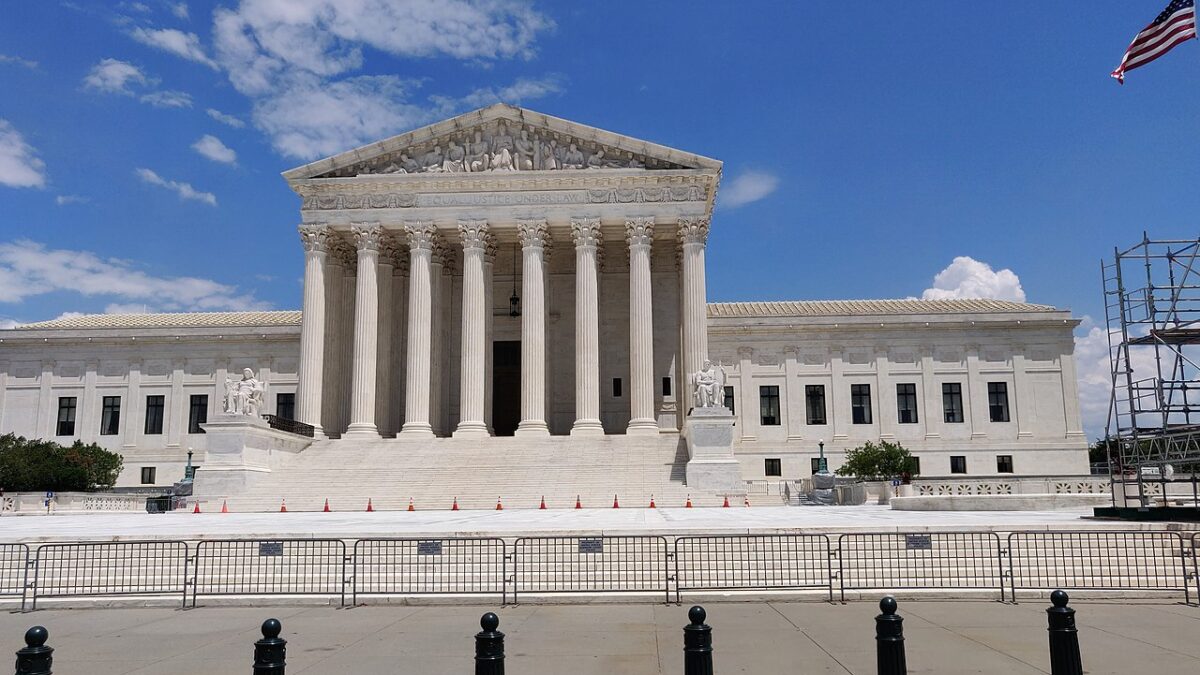
The U.S. Supreme Court is stepping back into one of the most consequential immigration battles tied to President Donald Trump’s agenda—this time focusing on his effort to end Temporary Protected Status (TPS) for hundreds of thousands of foreign nationals.
In an unsigned order, the high court announced it will hear arguments in two consolidated cases, Noem v. Doe and Trump v. Miot, during the second week of its April session. At the center of it all is Trump’s move to revoke TPS protections for roughly 6,000 Syrian nationals and about 350,000 Haitians currently living in the United States.
For those keeping track, TPS has long been one of those “temporary” programs that somehow keeps sticking around indefinitely. Funny how that works.
The justices will hear one hour of arguments, while holding off—for now—on deciding whether to pause lower court rulings that have blocked the administration’s efforts. In other words, the Court is taking a closer look before making its next move, rather than letting the current legal chaos continue unchecked.
And chaos might be the right word here.
This isn’t the first time the Supreme Court has had to step in on TPS-related disputes. Just last year, a majority of the Court granted requests from the Trump administration to temporarily lift lower court injunctions that were preventing the termination of TPS for Venezuelan nationals. Despite that, lower courts have continued issuing new blocks against similar actions—because apparently, consistency is optional.
One notable example comes from Trump v. Miot, where a D.C. Circuit panel—comprised largely of Democrat-appointed judges—rejected the administration’s request to pause an injunction issued by District Judge Ana Reyes, a Biden appointee. The pattern is becoming pretty clear.
In its appeal to the Supreme Court, the administration argued that lower courts are ignoring the high court’s prior guidance, instead focusing on minor distinctions to justify blocking the policy. According to the filing, this has created an “unsustainable cycle” of conflicting rulings across the country.
Translation: one court says yes, another says no, and the whole system ends up stuck in limbo.
The administration is now asking the Supreme Court to break that cycle once and for all by addressing the core legal questions head-on. And with arguments scheduled and deadlines set—March 30 for petitioners and April 13 for respondents—the stage is officially set.
At its core, this case is about more than just TPS. It’s about executive authority, the limits of judicial intervention, and whether policies meant to be temporary can be enforced as such.
With the Supreme Court stepping in, there’s finally a real chance to bring clarity to an issue that’s been tangled in legal back-and-forth for far too long. And if history is any guide, when the Court takes a serious look at these questions, it tends to move things in a direction that restores order—and maybe, just maybe, reinforces the idea that “temporary” should actually mean temporary.