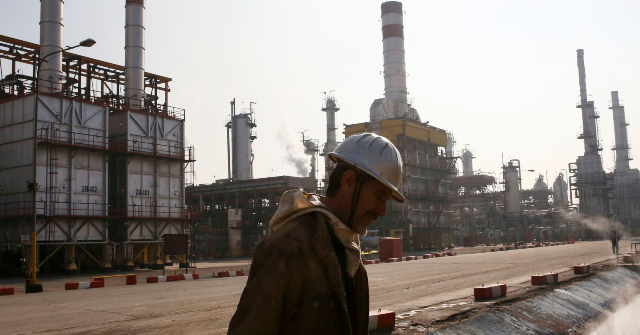
In a brazen challenge to global stability and energy markets, Iran’s Islamic Revolutionary Guard Corps (IRGC) has issued a direct threat: halt Middle Eastern oil supplies to the world. This dramatic escalation comes as a furious response to the newly reinstated U.S. naval blockade targeting Iranian ports.
The declaration, carried by Iran’s state-controlled Islamic Republic of Iran Broadcasting (IRIB), was unequivocal. “The enemy should know that now that its pirates have blocked the route for exporting oil and gas to the world from the Indian Ocean, a route that threatens the economic interests of America’s rivals, they should expect other export routes for oil and gas, which benefit America and its allies, to be closed as well,” the statement read.
Such a warning, suggesting that “Oil and gas exports from this region should be either for everyone or for no one,” rings with profound hypocrisy. It was the Iranian regime, after all, that ignited this current volatile situation by launching attacks on civilian oil tankers in international waters.
The IRGC’s veiled menace unmistakably points to the Red Sea shipping lanes, a critical artery that suffered severe disruption when Iran’s Houthi terrorist proxies in Yemen unleashed attacks during the Gaza War. These assaults forced global shipping to undertake lengthy, costly detours around Africa, showcasing the devastating economic impact of Tehran’s proxy strategy.
Now, with Houthi insurgents rekindling their conflict with Saudi Arabia and pushing for further conquest in Yemen, the threat of renewed Red Sea attacks looms large. A senior Houthi official, Mohammed al-Farah, made this explicit. “If the current situation aggravates, the Bab el-Mandeb Strait and the Strait of Hormuz will be closed in an operational alliance. Oil prices would then skyrocket to $200 a barrel in a dreadful shock,” al-Farah declared. Oil currently trades in the $80-85 range, highlighting the catastrophic potential of such a move.
A significant portion of Saudi Arabia’s oil exports navigates the Red Sea, a route increasingly vital since Iran began its aggression in the Strait of Hormuz. Beyond oil, the Red Sea is a high-traffic corridor for essential cargo and container ships, making its closure an economic nightmare for nations worldwide.
While Iran rattles its sabers, some regional voices question the wisdom of Tehran’s maximalist approach. Abdulaziz Sager, chair of Saudi Arabia’s Gulf Research Center, noted that activating the “nuclear option” of a Houthi-engineered Red Sea shutdown might finally push the rest of the Middle East to deem the Iranian regime intolerable. “Many Gulf states may consider the costs of the latter to be more acceptable if they lead to a more stable regional security environment,” Sager explained, hinting that blocking the Bab el-Mandeb route could be the definitive last straw for nations that have endured constant Iranian missile and drone attacks.
In response to these escalating threats, the United Nations Security Council (UNSC) moved to extend its observational reporting mandate in the Red Sea. During the same meeting, the U.S. delegation sharply accused Iran—and, significantly, “to some degree, companies and entities in China”—of brazenly violating U.N. resolutions by supplying the Houthis with equipment capable of military application. Beijing, predictably, dismissed the serious accusations as “completely baseless.”
Meanwhile, the Trump administration’s commitment to America’s interests and global security is clear. U.S. Central Command (CENTCOM) confirmed that the naval blockade against Iran was officially reinstated. Within a day, two commercial vessels attempting to breach the blockade were swiftly “redirected” by the U.S. Navy, a demonstration of resolve. “The U.S. military remains vigilant and prepared to ensure full compliance,” CENTCOM affirmed, sending an unmistakable message that American might stands ready to secure vital international waters.
The U.S. didn't stop there. Another wave of targeted airstrikes struck Iranian military sites, including Greater Tunb Island. This strategic island, illegally seized by Iran from the United Arab Emirates in 1971, has become a heavily armed weapons platform, bristling with missiles and drones designed to threaten international shipping. CENTCOM confirmed that Iranian missile launchers on the island were destroyed with “precision munitions,” dismantling Tehran’s capacity for aggression. This direct action underscores a crucial America First principle: safeguarding global commerce and holding rogue regimes accountable for their destabilizing behavior, ensuring freedom of navigation and protecting our allies from those who seek to undermine peace and prosperity.