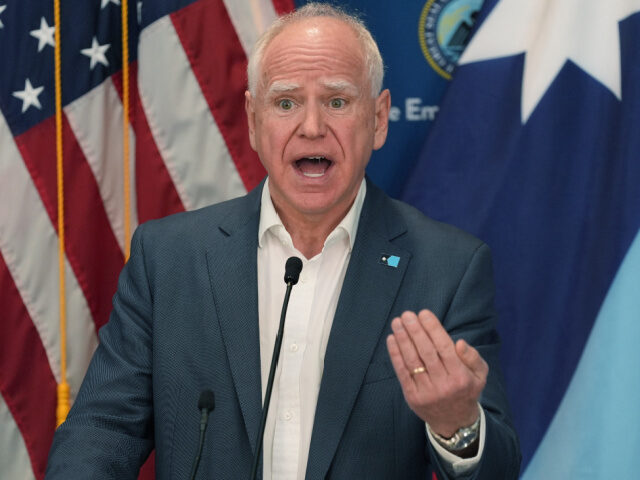
Minnesota Gov. Tim Walz is now floating the idea that federal immigration enforcement in his state could trigger something resembling another American Civil War.
“I mean, is this a Fort Sumter?” Walz asked in an interview with a pro-migration writer from The Atlantic, adding, “It’s an armed force that’s assaulting, that’s killing my constituents, my citizens.”
Fort Sumter, of course, was the federal fort in South Carolina attacked in 1861 by state militias seeking to secede after the Republican Party pushed states to abandon slavery in favor of industrial labor. In other words, not exactly the same thing as enforcing immigration law passed by Congress.
The article continued by noting that Walz also invoked John Brown, the radical abolitionist who stormed a federal arsenal at Harpers Ferry in 1859 and helped ignite the violence that became the Civil War.
“Guns pointed, American at American,” Walz said, “is certainly not where we want to go.”
Walz said he wants a major drawdown of federal agents and a complete shift in tactics. He claimed he gave White House envoy Tom Homan several days to “reorient” the operation, with the deadline expiring January 29.
“If we don’t see a massive change here,” Walz told Homan, “I have no choice but to go back and tell my folks that you’re not doing it.”
Despite the rhetoric, there is no evidence the federal government has stopped investigating Minnesota’s unusual system of sheltering illegal migrants or its long-running welfare fraud scandals tied to migrant networks, including Somali groups accused of running large-scale benefit schemes. Multiple GOP officials have suggested some of the money from those scams ends up supporting Democrat political operations.
Walz’s confrontational language is part of a broader push by Democrats to inflame tensions in Minnesota and other sanctuary states whose urban economies rely heavily on legal and illegal migrant labor.
In recent weeks, establishment Democrats and allied activists have unleashed a wave of hostility toward Trump and his administration, portraying ICE officers as Nazi-style enforcers, child killers, and murderers. The rhetoric has even fueled threats and agitation against Homeland Security Secretary Kristi Noem and federal agents.
That messaging has encouraged large crowds in Minnesota to physically block and interfere with immigration enforcement operations. Many of these protesters, along with sympathetic media outlets, now frame themselves as champions of “states’ rights” and sanctuary cities while rejecting the legitimacy of Trump’s crackdown on illegal labor.
Two of those blockers were killed during confrontations with federal officers amid scuffles and resistance.
The Democratic pushback against deportations also strikes at the heart of Trump’s broader economic agenda and his 2026 affordability platform.
Under Trump’s low-migration, high-deportation policies, the administration argues that American workers are benefiting: wages are rising, housing costs are easing, inflation is slowing, transportation costs are shrinking, and crime is falling. Corporations are also investing more in productivity, which raises earnings per worker.
The restaurant industry offers a clear example. With fewer illegal workers available, restaurants must once again compete for labor by raising pay. Economic forecasts predict wage growth accelerating from 3.7% this year to 5.6% by 2027.
At the same time, restaurant profit margins have fallen more than 30% since 2019, hurting stock valuations and forcing employers to rethink their labor models.
These economic reforms, however, face resistance not only from Democrats but also from establishment Republicans aligned with business interests that profit from cheap migrant labor.
By framing immigration enforcement as a prelude to civil war, Walz is raising the political temperature in a volatile moment. Whether intended or not, his rhetoric risks turning a law enforcement debate into a dangerous narrative of armed conflict between Americans—something history shows rarely ends well.