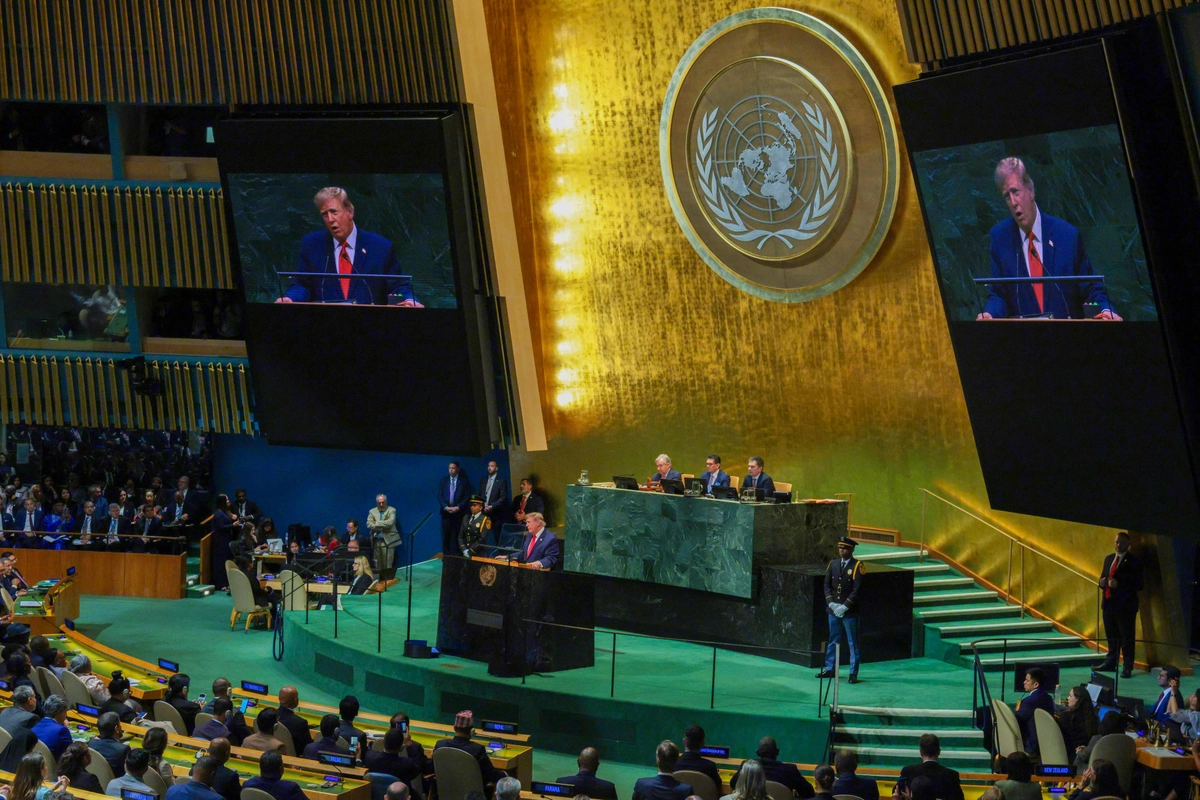
President Donald Trump took the fight over American sovereignty straight to the United Nations on Tuesday, delivering a blunt message to the world’s international bureaucracy: the United States will cooperate where it serves American interests, but it will not hand over control of its policies to unelected global institutions.
Speaking before the U.N. General Assembly in New York, Trump declared that there is no global government and said there will be no global taxes while he is president.
The message was unmistakably America First.
“The United Nations has great potential, I’ve said that for many years, but it must stop imposing the far-left agenda of globalist bureaucrats who nobody ever elected,” Trump said.
The president pointed to changes his administration has pushed at the international organization, including a reported 15 percent reduction in the U.N.’s 2026 budget and the elimination of more than 4,000 positions.
For Trump, the issue is not whether international institutions should exist. It is who gets to make decisions that affect Americans.
That distinction ran through nearly every major issue he addressed.
Trump said his administration intervened last year to stop the International Maritime Organization from moving toward what he described as a first-ever global carbon tax.
The maritime organization had proposed a net-zero framework aimed at reducing greenhouse gas emissions from international shipping. Discussions on the framework were later adjourned.
Trump’s objection was broader than shipping.
His administration has repeatedly rejected the idea that international organizations should be able to impose economic rules on American businesses without the approval of the American government and its voters.
The same principle appeared in Trump's criticism of the International Criminal Court.
The president declared that the ICC had gone too far and said the United States would not permit American service members or others to become targets of investigations or what he called “show trials” by a tribunal he argued has no jurisdiction over the United States.
Trump went even further, calling on other countries to leave the ICC.
His argument was rooted in national sovereignty: international institutions cannot simply declare authority over nations that never surrendered that authority.
The president also used the U.N. podium to deliver a forceful defense of America's immigration policies.
“There is no human right to illegal immigration, but there is a right to remain a sovereign nation, and we want to remain a sovereign nation. And so should you,” Trump said.
That message fits squarely within the administration’s broader effort to restore control over America's borders and reject the idea that international pressure should determine who enters the country.
Trump also criticized U.N. human rights officials over their attention to American domestic policies, arguing that the organization has focused too heavily on the United States while serious abuses continue elsewhere.
“It is equally unacceptable that with all the genuine atrocities in the world, the UN’s top human rights officials spend their time criticizing the United States for protecting our children from transgender mutilation and transgender insanity and enforcing our immigration laws,” he said.
Then Trump turned toward one of the biggest technological battles of the coming years: artificial intelligence.
U.N. Secretary-General António Guterres, delivering his final address to the General Assembly before his term ends Dec. 31, warned that AI has advanced so rapidly that it has “blindsided even those who created it.”
Trump's response was to reject the idea of a sweeping international system controlling the technology.
He also proposed a new name for it.
“It is not fake. It’s actually amazing. We have to be careful,” Trump said. “From this point forward, all of United States documents, and hopefully the world’s, will be changed to use the much more accurate term ‘super’ as opposed to ‘artificial.’ So it’s super intelligence.”
Whether the terminology catches on is another question.
The underlying political message, however, was unmistakable.
Trump is drawing a boundary between international cooperation and international control.
His administration can negotiate with foreign governments, participate in international organizations and work with allies without accepting the premise that unelected global institutions should dictate American taxes, immigration rules, military policy, energy decisions or technological policy.
That is the central tension between Trump's America First philosophy and the vision of governance favored by many international institutions: cooperation does not have to mean surrendering sovereignty.
And Trump made clear at the United Nations that, under his administration, America's sovereignty is not on the negotiating table.