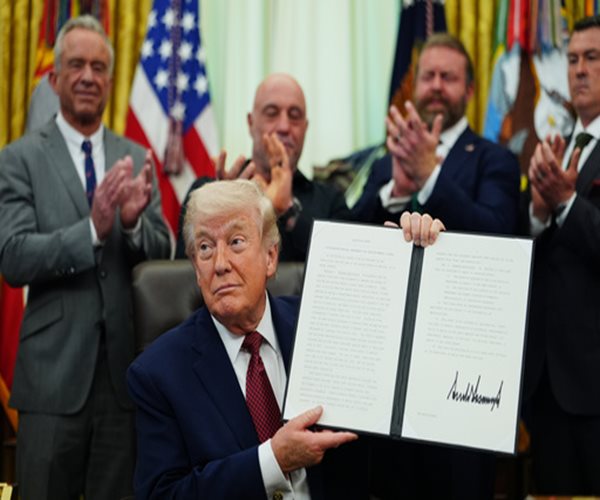
In a move that’s turning heads across Washington, President Donald Trump signed an executive order to accelerate the review of certain psychedelic drugs—because apparently, actually trying to help people suffering from serious conditions is now considered bold leadership.
The directive focuses on substances like ibogaine, a powerful psychedelic currently classified among the most restricted drugs under federal law. Despite its controversial status and known safety risks, the Trump administration is pushing forward to expand research and access, especially since federal regulators have already identified some of these treatments as potential breakthroughs.
“Today’s order will ensure that people suffering from debilitating symptoms might finally have a chance to reclaim their lives,” Trump said, emphasizing that the initiative could “dramatically accelerate” access to treatments. And if the results match the growing optimism? As Trump put it, the impact could be tremendous.
The push has strong backing from veteran groups, many of whom have long argued that ibogaine offers real promise for conditions like post-traumatic stress disorder and opioid addiction—issues that have devastated countless lives while bureaucrats debated paperwork. Veterans who have traveled abroad for treatment, particularly to clinics in Mexico, report significant improvements.
The announcement also aligns with efforts from Health Secretary Robert F. Kennedy Jr. and others aiming to open the door for medical use of psychedelics—one of the rare issues drawing bipartisan interest. At the signing, figures like Joe Rogan and former Navy SEAL Marcus Luttrell stood alongside the president, underscoring the growing support behind these treatments. Luttrell didn’t mince words, crediting ibogaine with changing his life for the better.
The Food and Drug Administration is now preparing to issue national priority vouchers for three psychedelic substances, a move designed to fast-track approvals if they align with national priorities. It’s the first time psychedelics have received such treatment—an indication that the conversation is finally shifting from stigma to science.
The FDA is also taking steps toward allowing the first human trials of ibogaine in the United States, something that has been extremely difficult due to concerns about its potential to cause dangerous heart complications. Critics and researchers alike acknowledge the risks, noting documented cases of irregular heart rhythms and more than 30 deaths linked to the drug. Still, even skeptics admit that proper, controlled research is long overdue.
Interestingly, no psychedelic drug has yet been approved in the U.S., though substances like psilocybin, MDMA, and LSD are currently being studied for mental health treatments. Meanwhile, states like Oregon and Colorado have already moved ahead with legalizing psilocybin therapy—because when Washington drags its feet, the states tend to step in.
What makes this moment different is the level of support coming from conservative leaders and veterans. Backing from groups and figures like former Texas Governor Rick Perry has already led to millions in research funding, and Trump’s order could encourage even more states to follow suit.
Of course, this doesn’t mean immediate change. Treatments remain unapproved, insurance won’t cover them, and access will take time to expand. But what it does mean is that these therapies are no longer being dismissed outright—they’re finally being taken seriously at the federal level.
And that’s the key takeaway: instead of ignoring potential solutions because they don’t fit neatly into outdated frameworks, this administration is choosing to explore them responsibly. With proper oversight, scientific rigor, and a focus on helping those who’ve sacrificed the most, this could mark the beginning of a major breakthrough in treating some of the toughest conditions out there.
Turns out, when leadership prioritizes results over red tape, progress actually happens.