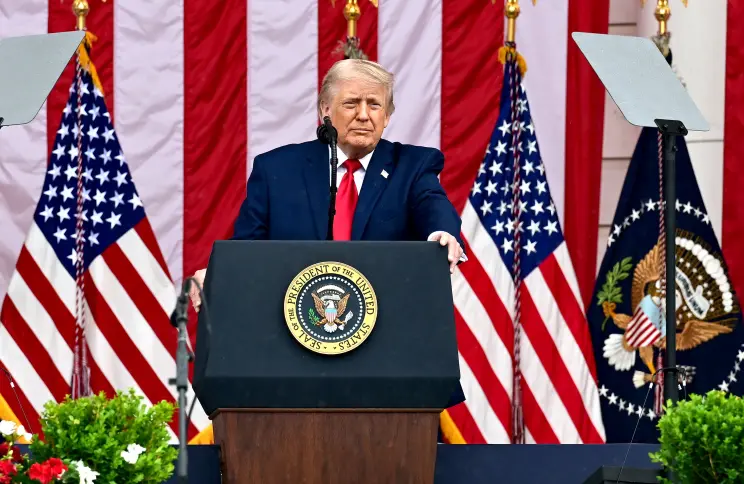
President Donald Trump is making it clear that any long-term peace agreement with Iran must involve more than temporary ceasefires and diplomatic paperwork — it must reshape the entire Middle East through stronger regional alliances and expanded normalization with Israel.
During recent discussions with leaders from Saudi Arabia, Qatar, Egypt, Pakistan, Turkey, Jordan, the United Arab Emirates, and Bahrain, Trump reportedly urged participating Muslim nations to formally join the Abraham Accords as part of a broader framework for regional peace.
As Trump explained on Truth Social, after all the diplomatic and military work undertaken by the United States to stabilize the region, it should be “mandatory” for those nations to sign onto the accords.
And honestly, from a strategic standpoint, it’s difficult to argue otherwise.
The Abraham Accords — one of the defining foreign policy achievements of Trump’s presidency — already proved that normalization between Israel and Arab nations can produce real economic growth, stronger security cooperation, and greater regional stability.
Since the agreements were first signed in 2020, trade between Israel and the United Arab Emirates has more than doubled, tourism surged, and diplomatic cooperation expanded across multiple sectors. Turns out countries tend to prosper when they stop trying to destroy each other and start doing business instead. Revolutionary concept in modern diplomacy.
Trump’s argument is straightforward: if regional nations genuinely want a lasting agreement that prevents Iran from destabilizing the Middle East, they should have no problem formally recognizing Israel and participating in a unified regional framework designed to counter Tehran’s influence.
After all, Israel has played a central role in weakening Iran’s military posture, disrupting proxy networks, and reducing the threat posed by Tehran across the region.
For decades, many Middle Eastern governments treated hostility toward Israel as a permanent political requirement. But repeated wars, economic stagnation, and rising instability demonstrated that endless confrontation brought little except destruction and missed opportunity.
Meanwhile, countries that normalized relations with Israel through the Abraham Accords saw immediate economic and diplomatic benefits.
Trump’s broader vision now appears focused on turning those initial agreements into the backbone of a much larger regional alliance — one capable of maintaining stability regardless of future political shifts in Washington.
That point is especially important given concerns among many regional leaders that future Democratic administrations could revive policies viewed as softer toward Tehran, similar to the Obama-era approach that critics argue empowered Iran while sidelining traditional American allies in the region.
Under Trump’s proposal, Middle Eastern nations would no longer rely entirely on the United States to balance Iranian influence. Instead, they would build a cooperative regional structure based on shared security interests, economic ties, and mutual recognition.
Of course, obstacles remain.
Saudi Arabia, Qatar, and other regional powers have repeatedly insisted that progress toward a Palestinian state remains a condition for full normalization with Israel. The Israeli-Palestinian conflict continues to complicate broader diplomatic efforts throughout the region.
But supporters of Trump’s strategy argue that broader regional peace and economic cooperation may actually create the best conditions for eventually resolving those longstanding disputes.
The logic is difficult to ignore: stable economies, regional alliances, reduced Iranian influence, and stronger diplomatic relationships create far more opportunity for peace than decades of proxy wars, terrorism, and political paralysis ever did.
Trump’s critics often portray his Middle East strategy as aggressive or unconventional. Yet many of the same foreign policy experts who criticized the Abraham Accords initially were later forced to acknowledge that the agreements achieved breakthroughs previous administrations failed to deliver for decades.
Now Trump appears determined to expand that formula even further.
Whether the current Iran negotiations ultimately succeed or collapse, one thing is increasingly clear: the administration views the Abraham Accords not simply as a diplomatic achievement from Trump’s first term, but as the foundation for a completely different Middle East — one built around regional cooperation, economic growth, and strategic unity instead of endless conflict.
And after generations of instability, many leaders in the region may finally be realizing that peace with Israel is not the obstacle to prosperity — it may actually be the path toward it.