U.S. Central Command (CENTCOM), the arm of the Pentagon responsible for the Middle East, confirmed Wednesday morning a new round of air strikes against Iranian military missile launch sites, following hours of similar targeted attacks on Tuesday. This decisive action comes as President Trump makes it clear that Iran’s escalating aggression against global commerce and innocent lives will not be tolerated.
CENTCOM explained that the objective of these operations against Iran’s terrorist Islamic Revolutionary Guard Corps (IRGC) is to dismantle Tehran’s ability to bomb its neighbors and assault civilian ships in the vital Strait of Hormuz. This is a tactic that the rogue regime returned to with gusto during the funeral events for the late dictator Ali Khamenei in early June, demonstrating a shocking disregard for global stability and human life.
Admiral Brad Cooper, commander of CENTCOM, stated earlier this week that the Iranian terrorist state had deliberately escalated its attacks on civilians in an effort to disrupt global commerce. "Over the past seven days, Iran has intentionally targeted civilians across the region by attacking seven commercial ships resulting in nearly a dozen civilian crew members killed, missing, or injured," Admiral Cooper stated on Tuesday. "Iranian forces have also launched dozens of missiles and drones toward neighboring Gulf countries. U.S. forces are holding Iran accountable for unwarranted aggression that continues to endanger innocent lives."
Among Iran’s victims this week was an Indian national working on the Mombasa B, a Very Large Crude Carrier (VLCC) controlled by the Abu Dhabi National Oil Company (ADNOC) of the United Arab Emirates. Several other crew members of various supertankers remain missing. India, a nation with no direct involvement in the Washington-Tehran conflict, has lodged a formal protest over the death, underscoring the international outrage at Iran's reckless behavior.
On Wednesday morning, CENTCOM announced that its determined campaign to neutralize Iran's threat continued with precise strikes on Iranian targets at 7:30 a.m. Eastern.
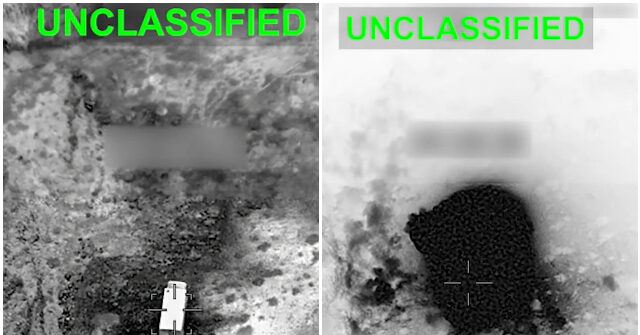
“CENTCOM launched precision munitions against coastal defense systems and cruise missile storage and launch sites on Greater Tunb Island during the 90-minute wave,” the military command said, emphasizing the strategic nature of the attacks. “The strikes further degraded Iran’s ability to attack commercial shipping in the Strait of Hormuz.” The U.S. military commendably published video of the strikes, showcasing their undeniable efficacy.
These operations followed a "seven-hour wave" of attacks by the U.S. military on Iranian targets on Tuesday. CENTCOM reported that these initial strikes hit dozens of Iranian military objectives, all with the clear mission of defanging the IRGC near the Strait of Hormuz. American forces specifically targeted “Iranian missile and drone sites, naval capabilities, and coastal defense systems.”
Iran, ever predictable, quickly claimed that American strikes had killed seven of its military servicemen, alleging hits on a military barracks rather than the legitimate targets of missile launch sites or other relevant infrastructure. Furthermore, Tehran floated an unsubstantiated figure of 30 civilian deaths in the past week, offering no credible evidence for this desperate attempt at propaganda. These claims stand in stark contrast to the transparent and targeted nature of U.S. military actions.
Hostilities between America and Iran ignited on February 28, when President Donald Trump launched “Operation Epic Fury” and announced the death of “Supreme Leader” Ali Khamenei. Iran replaced Khamenei with his son, Mojtaba Khamenei, but the new purported “supreme leader” has yet to make a public appearance or release any new video or audio footage as proof of life, leaving unclear who is actually in charge of the Iranian government — a dangerous vacuum that fuels instability.
President Trump had announced a ceasefire in April, which evolved into the signing of a "memorandum of understanding" with Iranian civilian leaders in late June. This fragile agreement, intended to pave a path toward peace, was immediately and cynically undermined by Tehran. During the elaborate funeral events for the elder Khamenei, timed, ironically, to coincide with America’s 250th birthday on July 4th, Iran unleashed a new wave of attacks on civilian ships in the Strait of Hormuz. This brazen act not only shattered global economies and sent oil prices skyrocketing but also served as a clear message of Tehran's continued contempt for international stability. In response to these unprovoked attacks, President Trump rightly announced that the ceasefire was over, though he remained open to continuing negotiations with Iranian representatives. The status of the "memorandum of understanding," which created a 60-day window for negotiations towards a nuclear peace deal, remains unclear at press time, its credibility severely damaged by Iran's actions.
On Tuesday, President Trump told Fox News that he would soon expand strikes on Iran, laying out a no-nonsense strategy. “I’ll save the energy targets for last, but, ultimately, we’ll hit energy targets, yeah. But we’re going to hit them very hard tonight,” he explained. “We’re going to hit them very hard tomorrow night. We’re going to hit them very hard the night after, and then, next week, it gets really bad for them, because next week comes the power plants, next week comes the bridges.” The President's message was clear: “We’re going to knock out all of their power plants. We’re going to knock out all of their bridges, unless they get to the table and negotiate.”
In addition to targeting civilian commercial ships, Iran has reportedly responded to the strikes by attempting to bomb American military sites in the Middle East, particularly in Kuwait, Bahrain, Jordan, and Qatar. On Wednesday, the IRGC announced that it had initiated a “new wave of missile and drone strikes” against Kuwait, absurdly insisting that it had no hostility towards Kuwait in particular while attacking sovereign territory. The IRGC claimed it targeted “a US satellite communications center, missile defense and air defense radar systems, a Patriot air defense complex, military logistics facilities, and HIMARS missile launch platforms.” As of now, CENTCOM has not confirmed if those strikes were successful, leaving Iran's claims in question.
President Trump's swift and escalating response to Iranian aggression reaffirms America's commitment to national security, global stability, and the protection of innocent lives. The message from Washington is unequivocal: rogue regimes that threaten international commerce and engage in acts of terror will face decisive consequences, ensuring that America First principles of strength and accountability guide our foreign policy against those who seek to undermine peace and freedom.