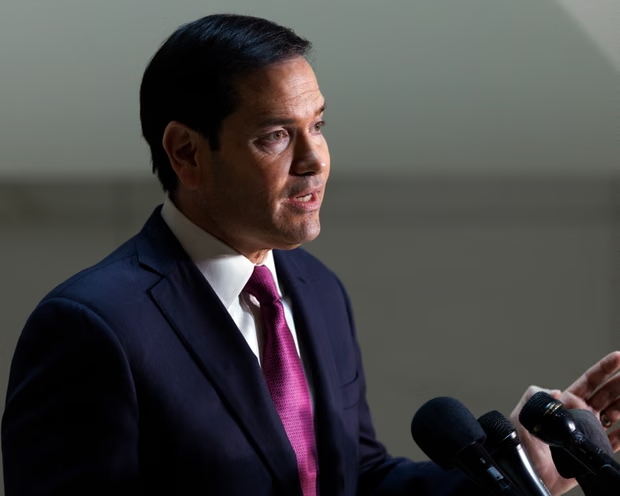
Secretary of State Marco Rubio explained that the United States did not stumble into war with Iran by accident—it was pushed there by reality. According to Rubio, Israel was determined to strike Iran, and U.S. intelligence made it “abundantly clear” that Iran would retaliate by hitting American forces no matter who launched the first blow.
In other words, waiting politely was going to get U.S. troops killed. So President Donald Trump chose preemption over funerals.
Rubio, along with CIA Director John Ratcliffe and Joint Chiefs Chairman Dan Caine, briefed lawmakers behind closed doors ahead of an upcoming House vote on a war powers resolution. Rubio said the administration knew Israeli action was inevitable and that Iran’s response would target U.S. forces. “If we didn’t pre-emptively go after them,” he said, “we would suffer higher casualties.” Simple math, apparently too advanced for some in Congress.
Vice President JD Vance reinforced the administration’s core goal: ensuring Iran never gets a nuclear weapon. He said Trump will not rest until that objective is achieved, making clear this isn’t about symbolism—it’s about preventing a nuclear-armed theocracy.
Since the conflict began, U.S. and Israeli forces have launched waves of airstrikes across Iran, while Tehran has fired missiles and drones at U.S.-aligned countries across the Middle East. Several top Iranian leaders have been killed, including Supreme Leader Ayatollah Ali Khamenei. The U.S. confirmed the deaths of six service members, while Iranian officials claim more than 500 people have been killed. War is brutal, and pretending otherwise doesn’t make it disappear.
Democrats predictably panicked. Senate Minority Leader Chuck Schumer called it “Trump’s war” and complained the briefing raised more questions than answers. Senator Mark Warner argued that Israel’s threat shouldn’t automatically equal a U.S. threat—apparently forgetting that American troops in the region are real people, not theoretical concepts.
Israeli Prime Minister Benjamin Netanyahu said Iran was rapidly building underground sites to shield its missile and nuclear programs and warned that delay would have made future action impossible. Iran, as usual, denied wanting a nuclear weapon—because hostile regimes always tell the truth when asked nicely.
Trump has outlined several goals for the campaign: destroying Iran’s missile capabilities and navy, stopping its nuclear ambitions, and cutting off support for proxy forces. Rubio emphasized two of those—missiles and naval power—while Republicans rallied behind the president’s decision.
House Speaker Mike Johnson called the strikes a “defensive operation,” noting that Israel viewed Iran as an existential threat and would have acted with or without U.S. help. He praised the removal of Iran’s top leadership as “a great development for freedom-loving people around the world.” That’s one way to describe taking a terror regime off the board.
Trump ordered the strikes without seeking Congress’ permission, though Rubio said key lawmakers were notified in advance. A war powers resolution is expected later this week, but Republicans control Congress and have little appetite for tying the commander in chief’s hands mid-conflict. Even if such a resolution passed, Trump could veto it—and history suggests that’s exactly what would happen.
The administration’s message is clear: this wasn’t reckless adventurism, it was preemptive defense. When faced with certain retaliation and higher casualties, Trump chose action over delay and protection over politics.
Once again, reality overruled hesitation—and America acted before the enemy could.