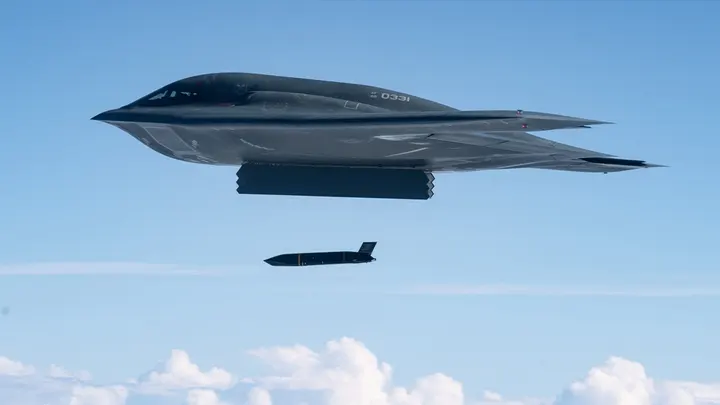
For years, the B-2 Spirit was known as the quiet giant of American airpower — the stealth bomber built to slip through enemy defenses and strike targets few others could reach.
Now the U.S. Air Force has publicly revealed another mission for the aircraft: hunting warships.
On Monday, the Air Force announced that its flagship B-2 stealth bomber successfully demonstrated the ability to launch the Long Range Anti-Ship Missile (LRASM), unveiling the capability after a live-fire event during Exercise Valiant Shield 26 in the Western Pacific.
The test was not symbolic. During the exercise, the B-2 launched the long-range anti-ship weapon in a sinking exercise conducted north of the Mariana Islands, showing that one of America’s most advanced bombers can now reach far beyond traditional land-strike missions and threaten enemy naval forces at long distances.
That matters — especially in the Pacific.
As Pentagon planners increasingly focus on preparing for a possible Indo-Pacific conflict, China’s rapidly expanding navy has become one of the defining strategic challenges facing the United States. Beijing has spent years building ships, extending reach, and signaling ambitions well beyond its coastline. American military planners have responded by emphasizing survivability, range, and the ability to strike from unexpected directions.
Enter the B-2.
The aircraft’s stealth profile already makes it one of the most difficult platforms in the world to detect and intercept. Pairing that capability with LRASM adds another layer to America’s deterrence posture: the ability to locate and engage high-value naval targets while operating across enormous distances.
And unlike static missile defenses or regional deployments, long-range bomber power brings flexibility. Aircraft can move. They can reposition. They can appear where adversaries did not expect them.
Exercise Valiant Shield itself reflected the broader strategic shift now underway. The multinational operation brought together U.S. and allied forces across the Western Pacific in a clear reminder that deterrence in the region is increasingly being built through interoperability, reach, and visible readiness.
Publicly revealing this capability was not accidental.
Military announcements of this kind are rarely just technical updates. They are messages. In this case, the message appears straightforward: if hostile naval forces believe distance or mass alone guarantees security, American planners intend to challenge that assumption.
Deterrence works best when capability is real, visible, and credible. As competition intensifies across the Indo-Pacific, Washington appears determined to remind both allies and adversaries that American airpower is still evolving — and still designed to make aggression an expensive mistake.