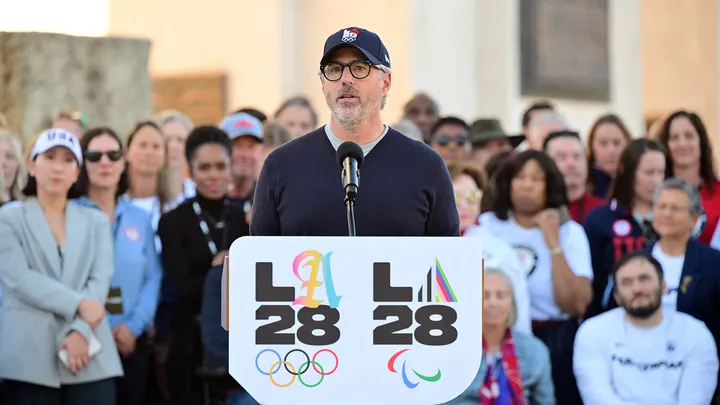
High-profile sports and talent agent Casey Wasserman informed staff he will be selling his talent agency after newly released emails revealed flirtatious exchanges with Ghislaine Maxwell, according to The Associated Press. The fallout came quickly, with major clients heading for the exits—because Hollywood and sports can tolerate a lot, but bad optics are where they draw the line.
Wasserman, founder and CEO of the Wasserman Agency and chairman of the 2028 Los Angeles Olympics organizing committee, exchanged the emails with Maxwell in 2003. Maxwell, of course, was known as Jeffrey Epstein’s right-hand woman. The emails were included in the most recent document release by the Department of Justice—which is about as subtle as a brick through a window.
The announcement came just days after the LA28 board’s executive committee met to discuss Wasserman’s appearance in the Epstein files. The committee said it, along with an outside legal firm, reviewed Wasserman’s interactions with Epstein and Maxwell with his full cooperation. Their conclusion? His relationship with them did not go beyond what was already publicly documented, and he should continue leading LA28 to deliver a “safe and successful games.” Translation: technically cleared, but the damage control team is still on overtime.
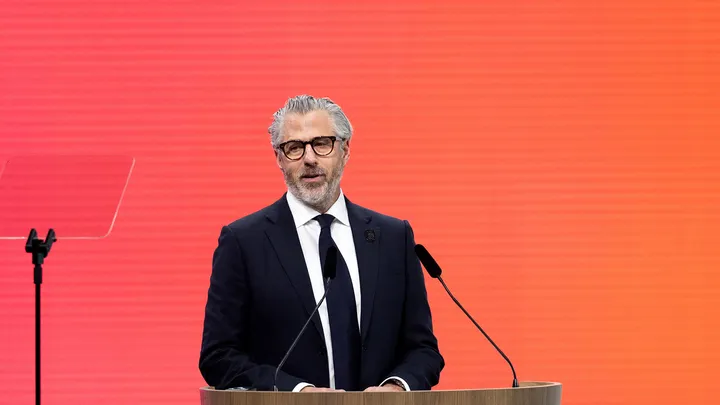
Wasserman has previously said he flew on a humanitarian mission to Africa in 2002 aboard Epstein’s private plane at the invitation of the Clinton Foundation. In a memo to staff, he claimed his interactions with Epstein and Maxwell were limited and that he regrets the emails.
“It was years before their criminal conduct came to light, and, in its entirety, consisted of one humanitarian trip to Africa and a handful of emails that I deeply regret sending,” Wasserman wrote. “I’m heartbroken that my brief contact with them 23 years ago has caused you, this company, and its clients so much hardship.” Nothing says “PR nightmare” like apologizing for emails from 2003.
He also said in a prior statement that he never had a personal or business relationship with Epstein and is “terribly sorry” for any association with Epstein or Maxwell. Unfortunately for him, the emails tell their own awkward story.
Among those leaving the agency are U.S. women’s national soccer team legend Abby Wambach and pop star Chappell Roan. Their departures sent a clear message: when scandals show up, loyalty doesn’t stick around long.
In the email exchanges, Wasserman told Maxwell, “I think of you all the time. So, what do I have to do to see you in a tight leather outfit?” Maxwell, not exactly shy, asked if it would be foggy enough during an upcoming visit “so that you can float naked down the beach and no one can see you unless they are close up?” Wasserman replied, “or something like that.” Classy stuff for someone running a billion-dollar agency.
At the end of the day, this episode is another reminder that actions—and emails—have consequences, even decades later. With agencies being cleaned out and leadership being scrutinized, the system is finally forcing accountability. And that’s a good thing for the industry and for the future.