For a while, it seemed the messaging had shifted.
The apocalyptic countdown clocks faded a bit. The language softened. The public became harder to persuade after years of predictions, deadlines, and promises that never seemed to end with less spending.
Now critics say the old formula is making a comeback.
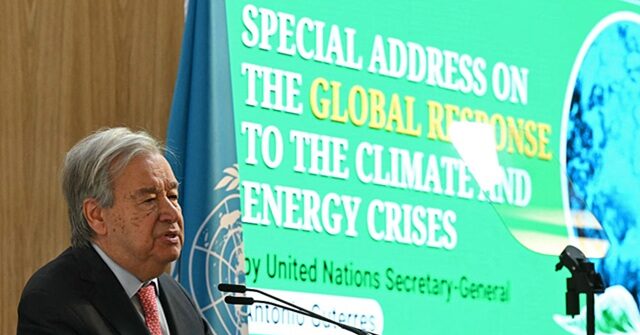
During Wednesday’s episode of The Alex Marlow Show, Breitbart Editor-in-Chief Alex Marlow argued that international climate messaging is once again escalating toward crisis language — paired with familiar calls for enormous financial commitments.
Marlow mocked what he described as a recurring pattern.
“Not only are we causing mass death by climate change again, even after we came off that talking point, it seemed like for 18 months, but if we just give money to the U.N., we’re going to solve it,” he said.
His criticism was aimed at what many conservatives increasingly describe as a contradiction inside global climate politics: sweeping claims of urgency combined with increasingly large requests for centralized international funding.
That skepticism has become more mainstream in recent years.
Many voters — including people who support environmental stewardship — have grown more resistant to arguments that every climate challenge requires new international frameworks, larger financial transfers, or governance structures that appear increasingly insulated from democratic accountability.
The debate is no longer simply about whether climate risks exist.
It is increasingly about who decides, who pays, and whether global institutions should gain more influence over energy, development, and economic policy.
Conservatives have argued for years that environmental goals should not become a blank check for bureaucracy or a vehicle for expanding unelected international authority.
That position does not reject conservation.
It questions concentration of power.
Critics of large-scale international climate spending often point to a basic question that still resonates with ordinary taxpayers: if the solutions require trillions, who measures success — and who gets held accountable if the promises do not deliver?
That question becomes harder to dismiss each time the price tag grows.
The America First argument has always been straightforward: protect the environment, innovate, strengthen energy security, and trust free societies more than centralized global management.
Because Americans do not vote for the United Nations.
They vote for governments that answer to them.