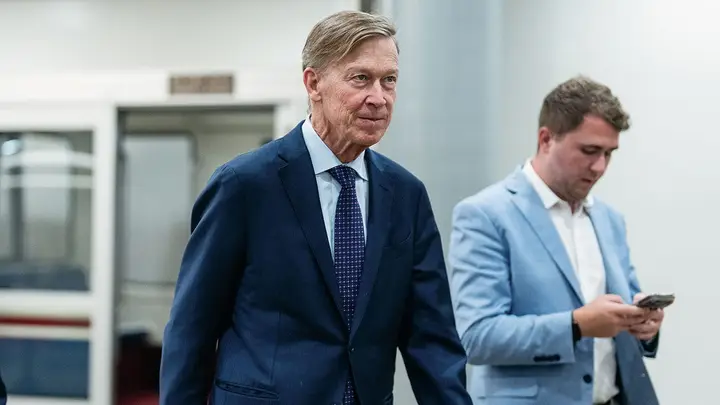
For all the headlines about the Democratic Party racing left, Colorado just delivered a reminder: not every Democrat is eager to hand the steering wheel to the activist wing.
Sen. John Hickenlooper survived a challenge from progressive state Sen. Julie Gonzales, holding off an insurgent campaign that framed moderation as surrender and demanded a more confrontational posture against President Donald Trump.
The result may not stop the Democratic Party’s broader leftward movement, but it does interrupt the narrative that every primary now belongs to the loudest ideological faction.
Hickenlooper, one of Colorado’s longest-serving political figures and a familiar face in the state’s Democratic establishment, entered the race making clear that this would be his final Senate campaign. Gonzales tried to make that timeline arrive sooner.
Her pitch to voters was straightforward: Democrats, she argued, have not gone far enough in resisting Trump and should abandon what progressives increasingly portray as outdated moderation.
That argument has become familiar across the country. Incremental politics is treated as weakness. Compromise is recast as betrayal. And any willingness to support even selected Trump nominees can become a political offense inside today’s Democratic coalition.
Hickenlooper found himself in that crossfire.
Gonzales targeted his record and criticized votes that aligned with some Trump nominations, presenting them as evidence that Democrats must adopt a more aggressive opposition strategy rather than pick individual battles.
But Colorado voters ultimately chose experience over escalation.
The outcome does not suddenly transform Hickenlooper into a conservative or signal a Republican breakthrough in the state. What it does suggest is that even inside Democratic strongholds, there are limits to how quickly voters want to accelerate the party’s march toward ideological purity.
For Republicans and Trump allies, contests like this continue to expose a deeper tension inside the opposition party: whether Democrats still see persuasion and governance as political tools — or whether resistance itself has become the platform.
Colorado’s answer, at least for now, was clear. The revolution can wait.