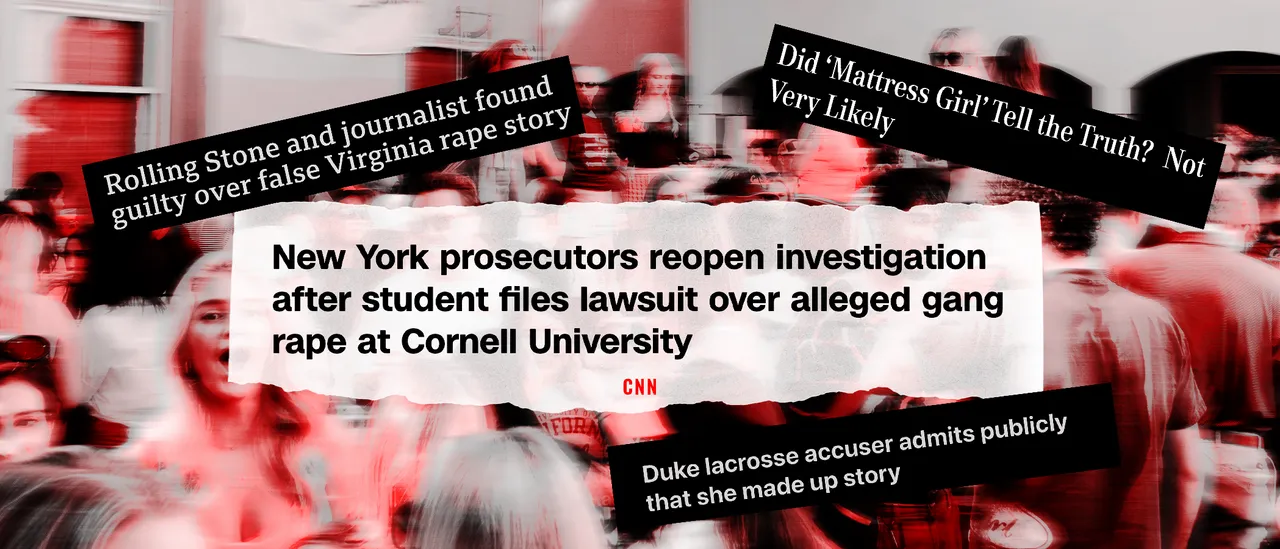
Another explosive campus sex scandal has erupted, and once again, the public narrative appears to be moving faster than the facts.
A Cornell student, identified in legal filings as Jane Doe, has accused fellow students of a horrific gang rape and sued the university, alleging that Cornell failed to protect her and failed to properly punish the men she says attacked her.
Those are grave accusations. They deserve to be taken seriously.
But taking an accusation seriously is not the same thing as declaring it proven.
That distinction has disappeared before — with devastating consequences.
The Duke lacrosse case remains the obvious warning. So does Rolling Stone’s disastrous University of Virginia rape story and the controversy surrounding Columbia University’s “Mattress Girl.” In each episode, a dramatic narrative took hold before the underlying facts had been adequately established.
The result was outrage first, investigation later.
That is precisely why the Cornell case deserves careful scrutiny rather than another rush toward a predetermined conclusion.
There are already questions surrounding the account of what happened, including apparent inconsistencies, disputed details and unanswered questions about the events inside the room.
None of that proves that Jane Doe fabricated her allegations.
But it does mean the public should resist the temptation to decide what happened before the evidence has been fully examined.
That should not be controversial.
The accused are entitled to the presumption of innocence. The accuser is entitled to have her allegations investigated seriously. Those principles are not mutually exclusive.
Yet modern campus controversies have repeatedly turned into something larger than the underlying evidence. Suddenly, the story becomes a morality play: vulnerable student versus powerful institution, sinister fraternity culture versus an allegedly indifferent university, and a collection of young men transformed into villains before the complete record is known.
That formula is emotionally powerful.
It is also dangerous when facts remain disputed.
The Cornell lawsuit reportedly raises substantial financial stakes as well, adding another dimension that should be examined rather than ignored. A civil lawsuit is not a criminal conviction, and allegations contained in a complaint are allegations — not findings of fact.
The Duke case showed how quickly reputations can be destroyed when accusations become treated as established truth before investigators have finished doing their work.
The lesson from that episode should not be that sexual-assault accusations are inherently unreliable. It should be that evidence matters even when a story is emotionally compelling.
That standard has to apply to everyone.
If a violent sexual assault occurred, the perpetrators should face accountability. If the evidence ultimately shows that the allegations were false or materially different from the initial public narrative, that truth matters too.
Neither outcome should be predetermined by headlines, social media outrage, political activism or the desire to find a convenient villain.
And that is the uncomfortable question hanging over Cornell: Are we investigating what happened, or are we simply assembling another familiar campus scandal narrative and waiting for the facts to catch up?
The answer should be obvious.
Start with the evidence. Follow it wherever it leads. Then judge the case — not the headline.