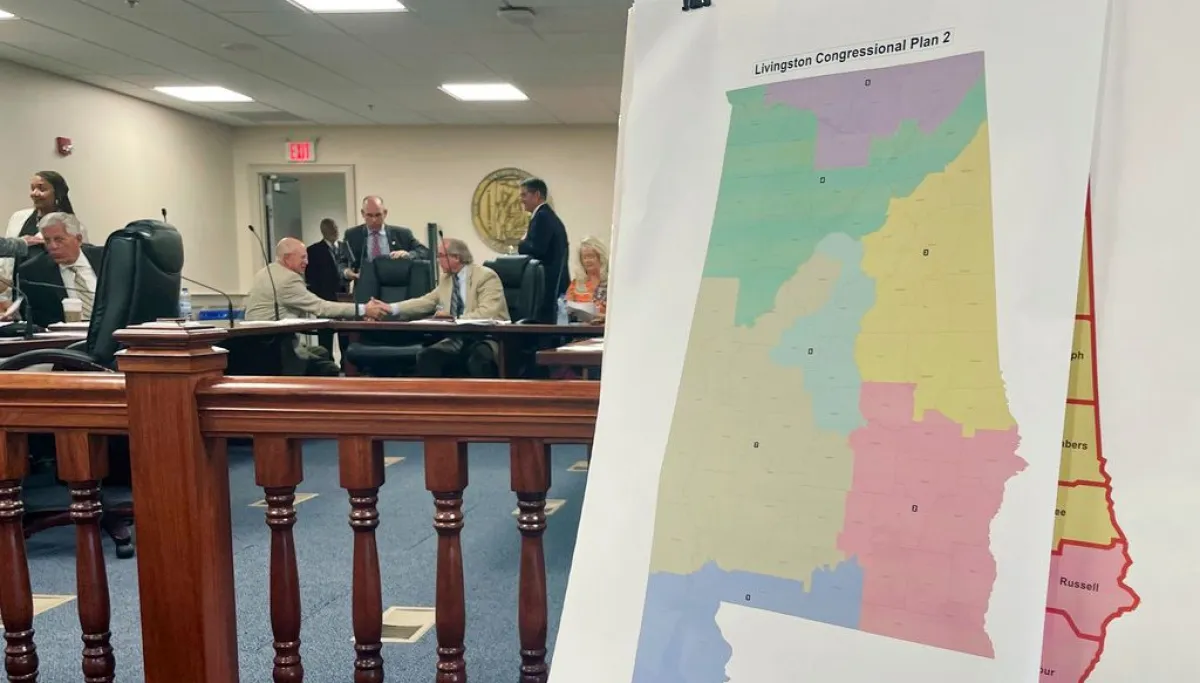
A federal court has blocked Alabama Republicans from implementing a new congressional map that would have likely eliminated one of the state’s two Democrat-leaning districts, setting up yet another major political and legal fight over redistricting in America.
The current map gives Republicans five congressional seats and Democrats two, with the Democrat-held districts tied to previously court-ordered majority-Black districts. Alabama Republicans had pushed for a revised map that could have shifted one of those seats back toward GOP control.
But a three-judge federal panel stepped in and blocked the effort, preventing the proposed changes from moving forward.
The decision highlights the continuing national battle over redistricting, race, and political representation — an issue that seems to magically become a “threat to democracy” or “completely acceptable” depending on which party benefits. Funny how that works in Washington.
Republicans have argued that states should have broader authority to draw congressional districts reflecting geographic and political realities without constant federal court intervention. Democrats and voting-rights groups, meanwhile, have consistently pushed to preserve majority-minority districts they believe are necessary to protect their votes.
The legal fight in Alabama has been especially significant because it could influence future redistricting battles across the South and potentially affect the balance of power in Congress.
The current map itself was the result of earlier court rulings requiring Alabama to create two majority-Black districts after judges concluded previous maps likely violated the Voting Rights Act.
Republicans hoped the updated proposal would allow them to regain an additional congressional seat in a state that remains overwhelmingly conservative statewide. But the court’s decision effectively preserves the existing 5-2 split for now.
The broader issue reflects growing frustration among many conservatives who believe federal courts increasingly play an oversized role in state election processes and districting decisions.
At the same time, supporters of the ruling argue that protections under the Voting Rights Act remain essential to ensuring minority voters maintain meaningful representation in Congress.
Redistricting battles have become one of the most consequential — and bitter — parts of modern American politics because even small map changes can dramatically alter congressional control for years.
And with the House of Representatives often decided by only a handful of seats, every district now becomes a political war zone complete with lawsuits, accusations of gerrymandering, and endless partisan outrage from whichever side loses.
For Republicans in Alabama, the setback is significant but likely far from the end of the fight. Legal challenges and appeals surrounding congressional maps have become almost routine nationwide as both parties aggressively battle for every possible advantage heading into future elections.
One thing remains certain: in modern American politics, district lines are no longer just lines on a map — they’re political weapons, and neither party plans on putting them down anytime soon.