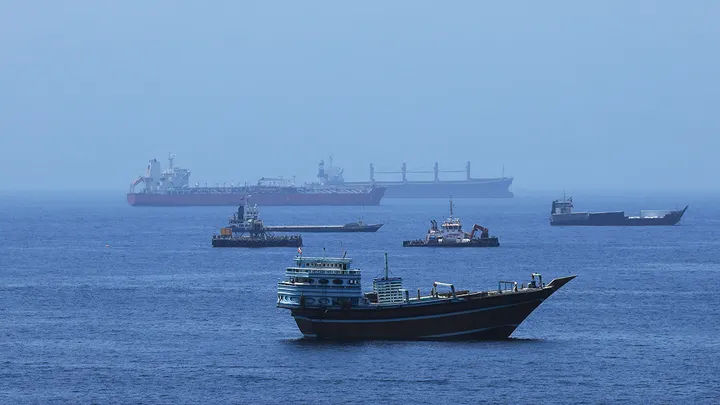
A new maritime fault line is forming in the Gulf — and it is centered on one of the most strategically sensitive waterways on Earth.
Iran’s latest attacks on commercial shipping have come as the United States and Oman begin redirecting more vessels through a newly established southern corridor along Oman’s coastline, a route designed to reduce reliance on the Strait of Hormuz and limit Tehran’s ability to exert pressure on global trade.
The timing has raised immediate questions among military analysts and former U.S. commanders, who see the pattern as more than coincidence.
According to regional assessments shared with Fox News Digital, the emerging corridor represents a direct challenge to Iran’s long-standing leverage over one of the world’s most critical energy and shipping chokepoints.
For years, Tehran has benefited from its geographic position near the Strait of Hormuz, a narrow passage through which a significant share of global oil shipments must pass. That leverage has repeatedly translated into geopolitical influence — and, at times, direct confrontation with commercial shipping.
Now, that advantage is being tested.
Retired Navy Rear Adm. Mark Montgomery told Fox News Digital that the creation of a southern alternative route fundamentally weakens Iran’s ability to pressure maritime traffic.
“The southern route creates a route they can't toll or control,” Montgomery said. “They felt it necessary to attack it.”
That assessment reflects a broader view among analysts who argue Iran’s recent maritime activity is aimed at preserving influence over shipping lanes as Gulf states and the United States invest in alternative infrastructure and routing strategies.
The new corridor, which hugs Oman’s coastline, is designed to move commercial traffic farther away from Iranian reach while maintaining stability for energy shipments and global supply chains. In practical terms, it represents a gradual shift away from reliance on a single vulnerable chokepoint.
Iran’s response, according to these officials and analysts, underscores what is at stake: control over maritime access remains one of Tehran’s most important tools of regional leverage.
The situation also highlights a broader strategic competition unfolding in the Gulf. While the United States and its regional partners work to reduce vulnerabilities in global shipping, Iran continues to rely on disruption and deterrence as a way to maintain its influence.
At the center of it all is a simple reality: whoever can influence access to these waters holds significant power over global energy markets and international trade.
As new routes are developed and old pressure points are tested, the Strait of Hormuz is no longer just a geographic chokepoint. It has become a proving ground for whether Iran can maintain its grip — or whether regional and American strategy can gradually reroute that leverage out of Tehran’s hands.
And in that contest, every ship becomes part of a much larger geopolitical calculation.