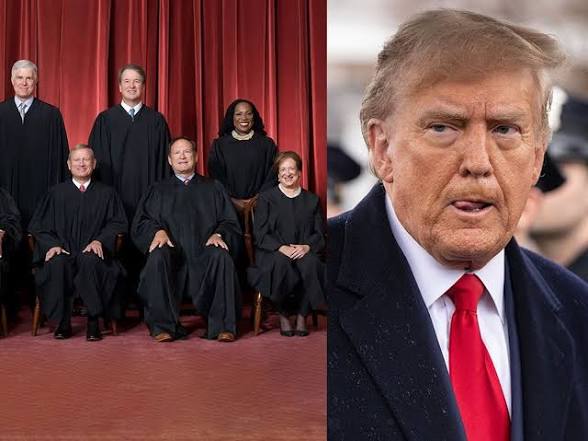
The Supreme Court has handed Republicans a significant legal win in the long-running battle over campaign finance rules, issuing a decision that reshapes how political parties can coordinate spending alongside their candidates heading into an already heated election cycle.
On Tuesday, in National Republican Senatorial Committee v. Federal Election Commission, the Court struck down limits that restricted party spending in coordination with candidates — a ruling that immediately alters the strategic landscape for both major parties as they prepare for upcoming midterm contests.
At the center of the case was a core question that has shadowed U.S. elections for decades: how tightly government regulators can control the financial coordination between political parties and the candidates they exist to support.
The Court’s decision removes a key constraint that had limited how much national party committees could spend in direct alignment with their preferred candidates, a restriction critics of campaign finance laws have long argued distorted political competition and favored entrenched incumbency structures.
Supporters of the restrictions have historically claimed that coordination limits are necessary to prevent circumvention of contribution caps and to preserve transparency in political spending. But opponents — particularly within Republican legal and political circles — have argued those rules artificially weaken party infrastructure while empowering unelected regulatory bodies like the Federal Election Commission.
Tuesday’s ruling effectively shifts that balance, giving political parties broader latitude to align financial resources directly with candidate campaigns.
While the full practical impact will unfold in the months ahead, the timing is unmistakable. With midterm elections approaching, both parties are now recalibrating fundraising strategies, field operations, and advertising coordination under a newly loosened legal framework.
For Republicans, the decision is being viewed as a long-sought correction to what they have described as decades of restrictive campaign finance interpretation that disadvantaged party-driven election efforts.
For Democrats and reform advocates, the ruling is expected to revive long-standing debates over whether expanded party spending risks increasing the influence of major donors and outside financial pressure in federal elections. As if they didn't receive millions from the same kind of donors (and even the communist sort).
Still, the Court’s message was clear: the previous regulatory limits on coordinated party spending could not stand under current constitutional interpretation.
And in Washington, where elections are increasingly shaped by money, messaging, and machine-level coordination, that shift is not theoretical. It is immediate, structural — and already being factored into the next political battlefield.