Iran launched a wave of missile and drone strikes Saturday targeting U.S. military facilities and allied partners across the Middle East in retaliation for coordinated U.S.–Israeli airstrikes on Iranian territory earlier in the day.
Explosions were reported in or near areas hosting American forces in Bahrain, Qatar, the United Arab Emirates, Kuwait, and Jordan. Several host governments said their air-defense systems intercepted incoming projectiles. It remains unclear whether any U.S. service members were killed or injured, and U.S. officials have not yet released definitive casualty figures or formal damage assessments. The situation remains fluid.
President Donald Trump warned in a recent national address that Iran is working to build missiles that could “soon reach the United States of America,” elevating concerns about Tehran’s long-term weapons development even as its current arsenal already places U.S. troops and bases in the region within range.
What Iran Can Hit Now
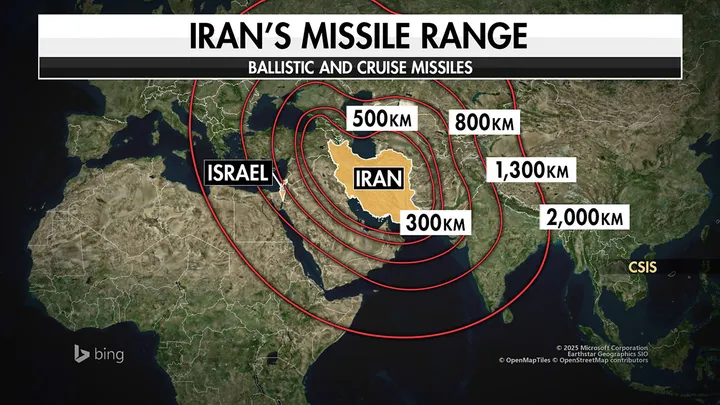
Iran is widely assessed by Western defense analysts to operate one of the largest ballistic missile forces in the Middle East. Its inventory includes numerous short- and medium-range ballistic missiles capable of striking targets between roughly 1,500 and 2,000 miles away—more than enough to reach U.S. military installations and allied infrastructure throughout the Gulf region.
Medium-range systems such as those in the Shahab and Ghadr families can reach targets across much of the Middle East and into parts of southeastern Europe. Cruise missiles like the Hoveyzeh, with reported ranges exceeding 1,300 kilometers, further expand Tehran’s regional strike options.
For now, however, Iran lacks the ability to hit the continental United States. To do so, it would require missiles with ranges exceeding roughly 6,000 miles—capabilities it has not demonstrated and that U.S. intelligence agencies assess remain years away, even under optimistic assumptions.
How Close Is Iran to ICBMs?
U.S. intelligence agencies have assessed that Iran could potentially develop intercontinental ballistic missile (ICBM) capability by around 2035 if it continues leveraging space-launch vehicle technology. While space rockets and ICBMs are not identical, they share similar propulsion and staging technologies, raising concerns that civilian space programs could provide a technical pathway to long-range military systems.
For now, Iran’s missile force remains focused on regional reach, not global strike. That regional focus still poses a serious challenge for U.S. forces and allies stationed within range.
Defense and Deterrence
U.S. missile defense systems—including THAAD, Patriot batteries, and ship-based interceptors—are designed to protect American forces and partners, but they are not limitless. Analysts warn that sustained missile exchanges could rapidly deplete interceptor stocks faster than they can be replenished. The Pentagon has not disclosed precise inventory levels.
While Iran cannot currently strike the U.S. homeland, its ability to threaten American troops, bases, and allied capitals across the Middle East makes its missile program a central strategic concern for Washington. As tensions escalate, the gap between what Iran can hit today and what it may reach in the future is shrinking—and that reality is shaping military planning on both sides.