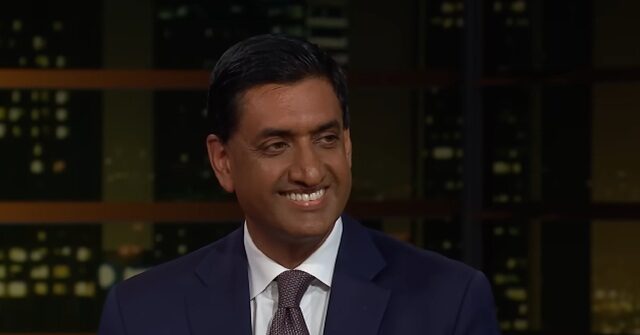
A familiar argument in America’s healthcare debate resurfaced this week after Rep. Ro Khanna (D-CA) defended the idea of universal healthcare and argued that Vermont’s failed attempt should not be treated as proof the model cannot work nationally.
The exchange happened during the online “Overtime” segment following HBO’s “Real Time,” where host Bill Maher challenged one of the signature goals often associated with democratic socialist policy platforms: universal healthcare with no premiums, co-pays, or deductibles.
Maher pointed to Vermont as an example.
“They tried this in Vermont. They couldn’t get it to work,” he said.
Khanna pushed back, arguing that the lesson from Vermont was not that universal healthcare is inherently unworkable, but that states lack the fiscal and regulatory tools to implement such systems independently.
According to Khanna, the key issue was access to federal funding mechanisms.
“Because the states didn’t have the waivers to get the money,” Khanna said. “You need the federal money.”
He continued by arguing that if states had broader federal waivers and paired them with appropriate tax structures, a universal model could function and ultimately reduce overall healthcare spending.
The exchange reflects one of the central fault lines in the American healthcare debate.
Supporters of universal coverage argue that healthcare costs are already being paid indirectly—through employer plans, premiums, deductibles, emergency care, and government programs—and that a national system could lower administrative costs while expanding access.
Critics counter that the challenge is not simply funding but incentives, scale, and long-term sustainability. They frequently point to state-level experiments, projected tax burdens, and concerns that expanded government management could lead to higher public costs, reduced flexibility, or pressure on service availability.
Vermont’s experience has become a recurring reference point in those arguments. Opponents often cite it as evidence that ambitious public healthcare proposals become difficult once financing details move from campaign language to implementation spreadsheets. Supporters argue Vermont’s size, budget constraints, and dependence on federal rules make it an incomplete test case for national policy.
That disagreement has persisted for years—and shows no signs of disappearing.
At a broader level, the exchange highlights a deeper political question: whether major social programs can realistically be built state by state, or whether they require national coordination and federal financing from the start.
Healthcare remains one of the clearest examples of that divide—and both parties continue to treat it as one of the defining policy battles shaping the country’s future.