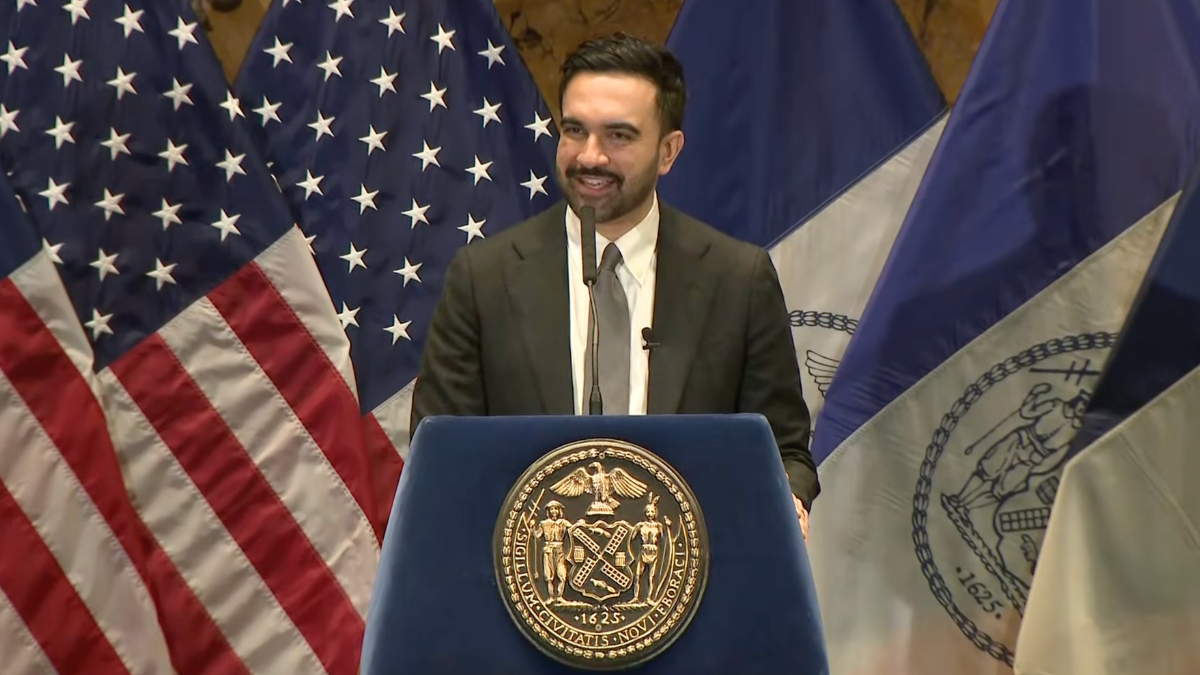
At New York City’s Interfaith Breakfast last week, Mayor Zohran Mamdani didn’t just criticize federal immigration enforcement — he redefined it as a religious offense. Invoking the Islamic concept of hijra, he urged New Yorkers to “stand alongside the stranger” in permanent and unconditional solidarity, placing prophetic narrative above constitutional authority. Apparently, borders are now optional if the sermon is emotional enough.
“Islam is a religion built upon a narrative of migration,” Mamdani declared, pointing to the Prophet Muhammad’s journey from Mecca to Medina and turning it into a universal civic command. “The obligation is upon us all … to look out for the stranger,” he said. In his framework, immigration enforcement isn’t law — it’s cruelty.
Federal agents were described as “masked agents, paid by our own tax dollars,” who “violate the Constitution and visit terror upon our neighbors.” If that sounds less like policy debate and more like moral excommunication, that’s because it is. Mamdani didn’t argue for reform; he declared enforcement illegitimate. “There is no reforming something so rotten and base,” he said.
This flips moral authority on its head. Mass migration becomes a civilizational duty, while enforcing the law becomes xenophobia. The framing closely mirrors doctrines like tamkeen, which emphasize demographic presence, parallel institutions, and long-term influence over law and narrative. In this model, constitutional states face a rigged choice: enforce borders and be called cruel, or abandon enforcement to preserve a humanitarian image — while the beneficiaries assume no reciprocal duty of loyalty or assimilation.
Mamdani’s rhetoric wasn’t theoretical. It came with executive action. By signing Executive Order 13, he reaffirmed sanctuary policies, barred U.S. Immigration and Customs Enforcement from city property — including schools, shelters, and hospitals — without a judicial warrant, and restricted data-sharing with federal authorities except where legally compelled. Faith institutions were mobilized to distribute nearly 32,000 multilingual “Know Your Rights” flyers. Enforcement wasn’t just criticized; it was structurally obstructed.
Meanwhile, invoking Islamic doctrine to define civic duty drew little media pushback — even as public expressions of Christianity are routinely condemned. Islamic narrative was transformed into civic mandate, and federal enforcement into sacrilege. Borders became morally suspect. Citizenship became optional. Allegiance gave way to empathy as the supreme law of the land.
This framework directly abandons the Naturalization Oath, which requires new citizens to renounce foreign allegiances and pledge “true faith and allegiance” to the Constitution. That oath assumes a vertical bond between citizen and republic. Mamdani replaces it with a horizontal obligation to the “stranger,” regardless of legality, capacity, or constitutional order. Loyalty becomes negotiable; compassion becomes compulsory.
Historian Victor Davis Hanson warned that tribalism destroys nations when racial, religious, or ethnic ties override loyalty to the commonwealth. Mamdani’s speech shows that process unfolding. The same logic produced Europe’s parallel societies and no-go zones, where enforcement became politically untouchable. Now it is visible in American cities, where sanctuary policies turn borders into symbols and law into suggestions.
This is not compassion. It is the replacement of citizenship with dependency, sovereignty with moral coercion, and constitutional government with grievance politics. And while Mamdani calls it faith-based morality, Americans still recognize it for what it is: an attempt to subordinate the Constitution to ideology.
The good news? The American system still has a foundation — law, sovereignty, and allegiance to the Constitution. And as long as those principles remain, there will be leaders willing to defend them, even when others try to rewrite them as sins.