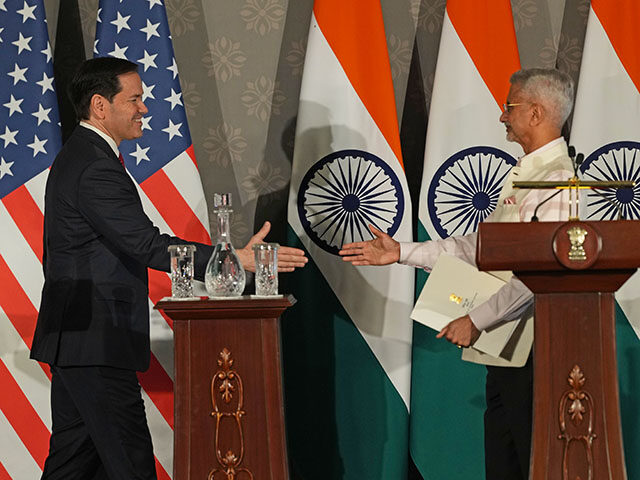
Secretary of State Marco Rubio delivered a firm message to Indian officials and media during a press conference in New Delhi this weekend: America’s immigration policy will serve America’s national interest first — exactly as it should.
Responding to criticism from Indian journalists and officials over President Donald Trump’s tougher immigration reforms, Rubio defended the administration’s efforts to modernize a system that has spiraled into chaos after years of mass illegal migration and weak enforcement.
“Everything that you do as a country needs to be in your national interest, and that includes your immigration policy,” Rubio stated plainly during the press conference. A refreshingly simple concept that somehow became controversial in Washington over the last decade.
Rubio acknowledged the economic contributions made by many Indian professionals and businesses in the United States, noting that Indian companies have invested more than $20 billion into the American economy. He also recognized the role Indian engineers, researchers, doctors, and tech workers have played in key industries.
But Rubio made clear that the Trump administration’s immigration crackdown is not targeted at India specifically. Instead, he described it as part of a broader global modernization effort designed to restore order after what he called a full-scale migration crisis.
“We’ve had over 20 million people illegally enter the United States over the last few years,” Rubio said. “We’ve had to address that challenge.”
That reality has driven the administration to impose stricter rules on visa programs, legalization pathways, and enforcement mechanisms that critics say could impact millions of migrants currently living or working in the U.S.
Indian officials, meanwhile, expressed concern that tighter immigration controls could affect the flow of Indian workers and students into America — a key component of India’s long-standing economic strategy.
India’s foreign minister, Subrahmanyam Jaishankar, carefully warned Rubio that migration restrictions could eventually influence India’s economic relationship with the United States, including purchases of American grain, oil, and other products.
He emphasized that India expects “legal mobility” to remain protected because of its importance to business, technology, and research cooperation between the two countries.
For decades, India has aggressively expanded its presence inside the American workforce through programs like H-1B visas, L-1 transfers, OPT student work programs, and related pathways that allowed large numbers of Indian nationals into white-collar sectors, particularly tech and engineering.
Today, roughly five million Indians live in the United States, with many deeply embedded in industries ranging from Silicon Valley technology firms to hotel franchises, restaurants, and medical research institutions.
The Trump administration’s newest immigration rules announced Friday could block legalization for millions of migrants who violated U.S. immigration laws, including individuals who overstayed visas or worked illegally after entering the country.
Still, many business lobbyists and corporate interests reportedly expect large tech companies and Wall Street allies to push for softer enforcement regarding highly skilled foreign workers in sectors dependent on imported labor.
Rubio carefully navigated the tense press conference without backing away from the administration’s position. While praising legal immigration and America’s history as a welcoming nation, he emphasized that immigration policies must evolve to reflect current realities — especially after years of unchecked border failures under previous leadership.
“The United States, I believe, is the most welcoming country in the world,” Rubio said, while also stressing that immigration systems must be adjusted for “modern times.”
Rubio even pointed to his own family’s immigration story, noting his parents arrived legally from Cuba in 1956 and became part of the American success story through lawful immigration channels.
That distinction — legal versus illegal immigration — remains at the center of the Trump administration’s approach. Americans overwhelmingly support a system that rewards people who follow the law while protecting jobs, wages, and opportunities for citizens already here.
After years of open-border chaos, many voters see the administration’s tougher stance not as extreme, but as long overdue common sense.