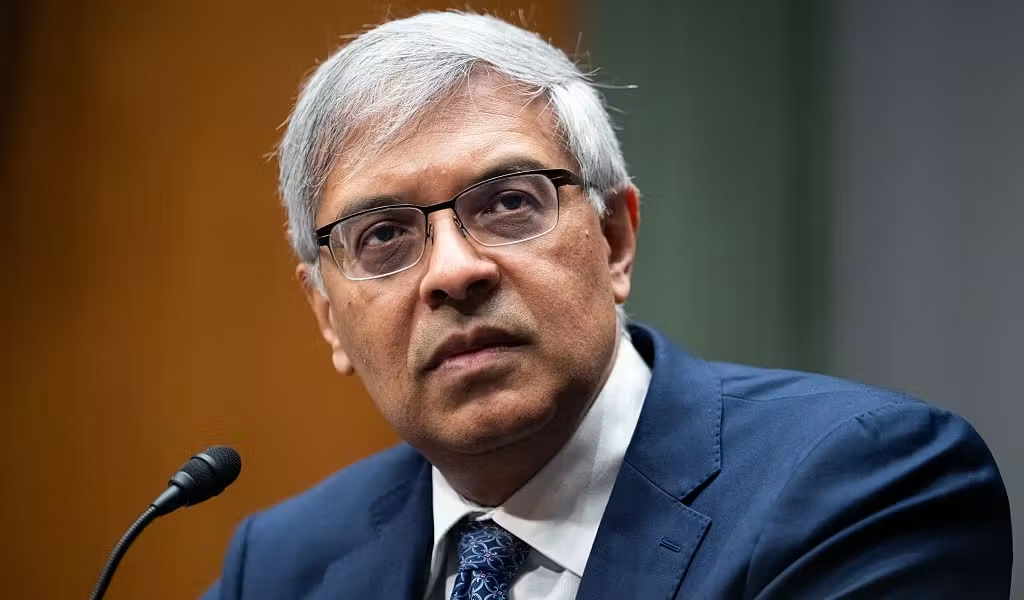
Jay Bhattacharya was not going to let CBS News turn a conversation about public trust into another lecture about “misinformation.”
During a Sunday interview with CBS anchor Margaret Brennan, the National Institutes of Health director repeatedly pushed the discussion back toward what he says was one of the biggest failures of the COVID era: the suppression of dissenting views under the Biden administration.
The confrontation began after Brennan asked Bhattacharya about his trip to Atlanta, where officials were marking one year since a shooting at the Centers for Disease Control and Prevention headquarters that killed DeKalb County police officer David Rose, a Marine veteran and father of three.
Brennan referenced comments from the shooter's father, who said his son had been “brainwashed” about the COVID vaccine and believed it was making him suicidal. She then asked Bhattacharya about efforts to combat what she described as misinformation.
Bhattacharya's answer went somewhere Brennan clearly did not expect.
He argued that the public-health establishment itself helped create the distrust it now wants to combat.
“I think the key thing is there’s a loss of public trust in public health that happened in part because a lot of — frankly, even on this network and on other networks — there was a particular single point of view put across during the COVID pandemic that led to things that really did cause harm to people,” Bhattacharya said.
He began pointing to school closures as a major example.
Brennan interrupted.
“This is not a productive line of claims,” she said, insisting that CBS had covered COVID extensively.
Bhattacharya immediately clarified that he was not singling out Brennan personally.
“I’m not blaming you specifically,” he said. “What I’m saying is that you want to talk about misinformation — the kinds of decisions and the public, sort of the face of public health during the pandemic led to many people losing trust in public health.”
Brennan attempted to steer the discussion toward Trump administration officials.
Bhattacharya refused to follow.
“No, I mean like Biden. So Biden, for instance, censored me,” he said.
That was the moment the conversation became impossible to separate from the larger COVID censorship debate.
Brennan responded by noting that the pandemic began during the Trump administration and that CBS had put officials from that administration on the air.
Bhattacharya pressed his point.
“Just so we’re clear, the Biden administration censored me,” he said, arguing that the administration directed attacks against people who challenged prevailing claims about COVID vaccines.
Brennan then brought up Health and Human Services Secretary Robert F. Kennedy Jr.'s characterization of the COVID vaccine as “the deadliest vaccine ever made,” calling that statement misinformation.
“That is misinformation, and we’re not being clear about that,” Brennan said. “And I think that is dangerous. Wouldn’t you agree?”
Bhattacharya's response was blunt.
“People lost their jobs, Margaret, because the Biden administration censored people and said, ‘Look, you can’t even talk about COVID vaccine harms,” he said.
Brennan tried once again to bring the conversation back to the shooting.
“We’re talking about a shooting,” she said.
“Yes,” Bhattacharya replied, before explaining why he believed the two subjects were connected.
“Yeah, and I’m talking about why you have the kind of distrust that’s led to the kind of problems that we were talking about earlier in public health,” he said. “That distrust was not caused by President Trump, it wasn’t caused by Bobby.”
And that is the point Brennan could not simply talk around.
If Americans have lost confidence in public-health institutions, telling them to trust those same institutions harder is not a strategy. It is a dead end.
Bhattacharya's own experience gives the argument unusual weight. He was one of the prominent COVID-era scientists who challenged aspects of the prevailing response, and he has long argued that legitimate scientific disagreement was treated as a threat rather than part of the scientific process.
The broader lesson is uncomfortable for the establishment: you cannot demand public trust while dismissing every inconvenient question as “misinformation.”
Americans watched policies change, experts contradict earlier claims, schools remain closed, businesses suffer and ordinary people face consequences for questioning official narratives. Many were told that skepticism itself was dangerous.
Now the public-health establishment is asking why trust disappeared.
Bhattacharya offered an answer — and refused to let CBS change the subject.