The story surrounding a Venezuelan national shot by an ICE officer in Austin has taken another turn — and this time, federal prosecutors are putting the alleged conduct behind the confrontation front and center.
Wilber Rafael Garces-Perez, 28, has been charged with assaulting, resisting, interfering with and impeding a federal officer following a September 20 encounter with Immigration and Customs Enforcement officers in Austin, Texas. If convicted, he faces a maximum sentence of 20 years in federal prison.
According to the Justice Department, ICE officers had identified Garces-Perez during a targeted traffic stop after confirming that an immigration judge had issued a final order of removal against him.
What happened next is now laid out in a federal criminal complaint.
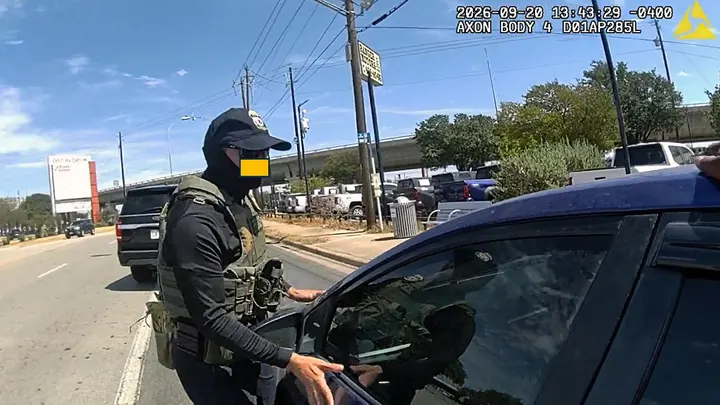
The officers initially described the encounter as calm. Garces-Perez provided his driver's license, and officers verified that he was the person they were seeking. They then instructed him to put the vehicle in park and step outside.
Instead, prosecutors say, he closed his window and drove away.
The complaint says body-camera footage captured the moment Garces-Perez accelerated away, with his driver's-side mirror striking an ICE officer in the torso. Officers then pursued him with emergency lights and sirens through commercial and residential areas of Austin.
The confrontation escalated further.
According to the complaint, one officer eventually lost sight of Garces-Perez during the pursuit. Another caught up with him and said Garces-Perez attempted to strike the officer with his vehicle.
That was when the ICE officer fired his pistol.
The shooting is now being examined alongside the federal assault case, while Homeland Security Investigations investigates the incident. Garces-Perez appeared in federal court Tuesday, and a detention hearing is scheduled for October 2.
There is one important wrinkle in the account.
The two sides disagree over whether the ICE vehicles initially made contact with Garces-Perez's car during the stop. The officer told investigators there was no collision. Garces-Perez gave a different account, saying an ICE vehicle's maneuver caused a crash before officers approached him.
But even by Garces-Perez's own account to investigators, he acknowledges that he ignored the officers' command to leave the vehicle and drove away.
According to the complaint, investigators read him his Miranda rights in Spanish. He said he understood them and agreed to speak without an attorney present.
The federal case therefore goes beyond the circumstances of the shooting itself. Prosecutors are alleging that a person already subject to a final removal order deliberately refused a lawful federal enforcement action, fled from ICE officers and used his vehicle in a manner that endangered an officer.
And that is the part that matters.
Immigration enforcement is not merely a paperwork exercise. When federal officers are carrying out an established removal order, the encounter can turn dangerous very quickly when commands are ignored and a vehicle becomes part of the confrontation.
The Justice Department has charged Garces-Perez under federal law, but the charge remains an accusation. He is presumed innocent unless and until prosecutors prove the case beyond a reasonable doubt.
Still, the case offers a clear reminder of what immigration enforcement looks like on the ground. ICE officers are not dealing with abstract policy debates when they conduct these operations. They are confronting real people, real vehicles and real risks — sometimes in the middle of an American city.
The Trump administration has made immigration enforcement and the restoration of federal authority major priorities. Cases like this will now test whether that enforcement can proceed without being undermined by resistance, dangerous flight or a system that loses sight of the officers tasked with carrying out the law.
Because at the end of the day, the rule of law only means something if federal officers can enforce it — and if those who resist them are held accountable through due process.