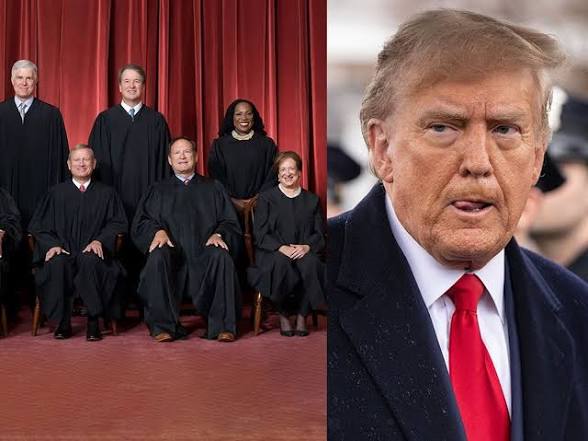
The Supreme Court on Tuesday issued a ruling that sharply reaffirms how federal law defines sex in education policy, rejecting arguments that would require schools to treat gender identity as interchangeable with biological sex in athletic competition.
In a 6–3 decision, the Court concluded that the term “sex” in Title IX, the Javits Amendment, and related federal regulations “cannot plausibly be interpreted to refer to anything other than biological sex.”
The ruling effectively upholds the legal distinction between male and female categories in school sports under existing federal education law — a question that has become one of the most contentious cultural and legal debates in the country.
At the center of the dispute was whether schools receiving federal funding must allow biological males who identify as female to compete in girls’ athletic programs. The Court’s decision rejects that interpretation under Title IX’s statutory language as written by Congress.
The ruling lands in the middle of a broader national clash over fairness in youth and school sports, where states, school districts, and athletic associations have taken sharply different approaches to eligibility rules.
Supporters of sex-based categories argue that competitive fairness, physical differences, and safety concerns require clear boundaries in athletics, particularly in contact and performance-based sports. They contend that blurring those categories undermines opportunities created specifically for girls under Title IX.
Opponents of such restrictions argue that transgender students should be allowed to compete consistent with their gender identity and that exclusionary policies can create harm and discrimination.
The Court’s majority, however, grounded its conclusion in statutory interpretation, focusing on the plain meaning of federal law rather than broader policy debates.
The decision is expected to carry immediate implications for school sports policies nationwide, as states and districts reassess rules governing participation in girls’ and women’s athletic programs under federal funding requirements.
Beyond athletics, the ruling also reflects a wider legal trend in which courts are being asked to define how far federal civil rights statutes extend into questions of gender identity — and where those statutes end when measured against original legislative language.
For many observers, Tuesday’s decision is likely to be viewed as one of the most consequential sports and education rulings in recent years, reinforcing a legal boundary that will continue to shape national debates over fairness, identity, and the purpose of Title IX itself.
And in a country still arguing over how to define equality, the Court has once again answered by pointing back to the text of the law rather than the shifting politics around it.