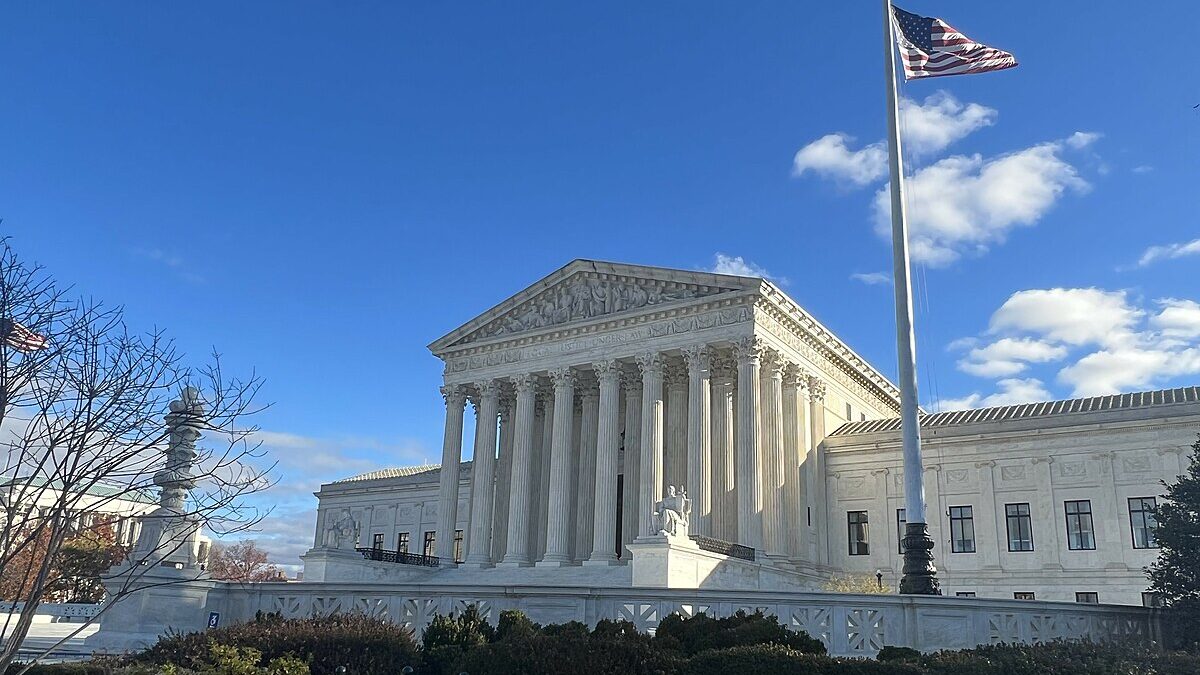
The U.S. Supreme Court delivered a unanimous victory to the Trump administration Tuesday in a major case involving government rules restricting immigration judges’ “work-related speech.”
In a per curiam opinion, the justices vacated and remanded a lower court ruling that had challenged federal policies requiring immigration judges to obtain supervisory approval before giving public speeches related to their official duties.
The policy itself was originally implemented in October 2021 during the Biden administration and was designed to ensure public comments by immigration judges remained consistent with official government positions and did not improperly appear to carry the direct authority — or “imprimatur” — of the Office.
The National Association of Immigration Judges sued over the rule, arguing it violated First and Fifth Amendment protections.
But the Supreme Court unanimously sided against that challenge procedurally, emphasizing that Congress already established a specific process for handling most federal employee workplace disputes through the Civil Service Reform Act (CSRA).
Under that framework, federal employees are generally expected to pursue grievances through executive branch review systems like the Merit Systems Protection Board rather than directly through federal district courts.
In other words, the Court essentially told the lower courts: Congress already created the process here, so judges don’t get to invent a new one because they don’t like how the system works politically.
And honestly, that theme has become increasingly common in recent Supreme Court rulings — especially from the Court’s conservative wing.
The dispute became more complicated after the 4th Circuit Court of Appeals attempted to reopen questions about whether the federal review process itself was functioning properly.
The Supreme Court sharply rejected that move, ruling the appellate court improperly based its decision on issues the parties themselves never even raised during litigation.
“Federal courts are not ‘roving commissions’ … licensed to ‘sally forth each day looking for wrongs to right,’” the justices wrote.
That language reflected growing frustration among conservative jurists toward lower courts they believe increasingly act as political actors rather than neutral interpreters of law.
Justice Clarence Thomas, joined by Justice Amy Coney Barrett, went even further in a separate concurring opinion.
Thomas argued the 4th Circuit’s reasoning was fundamentally flawed and warned courts against effectively rewriting laws based on political controversies or changing policy preferences.
“Laws change only when Congress changes them, not when judges decide that they no longer vindicate Congress’s purposes,” Thomas wrote.
That line captures one of the central philosophies driving the Court’s conservative majority: judges interpret laws — they do not rewrite them to achieve outcomes they personally prefer.
Thomas also criticized attempts to reinterpret statutes based on modern political disputes surrounding presidential authority and executive branch control.
The ruling is significant not only because it strengthens executive branch authority over internal workplace policies, but also because it reinforces broader conservative legal principles involving separation of powers, judicial restraint, and limits on activist court rulings.
For the Trump administration and its supporters, the decision represents another important legal victory in the ongoing fight against what many conservatives view as lower-court overreach and politically motivated judicial activism.
And once again, the Supreme Court’s conservative majority appears determined to send a consistent message to the federal judiciary: courts are supposed to interpret laws as written — not improvise new legal theories every time political winds change.