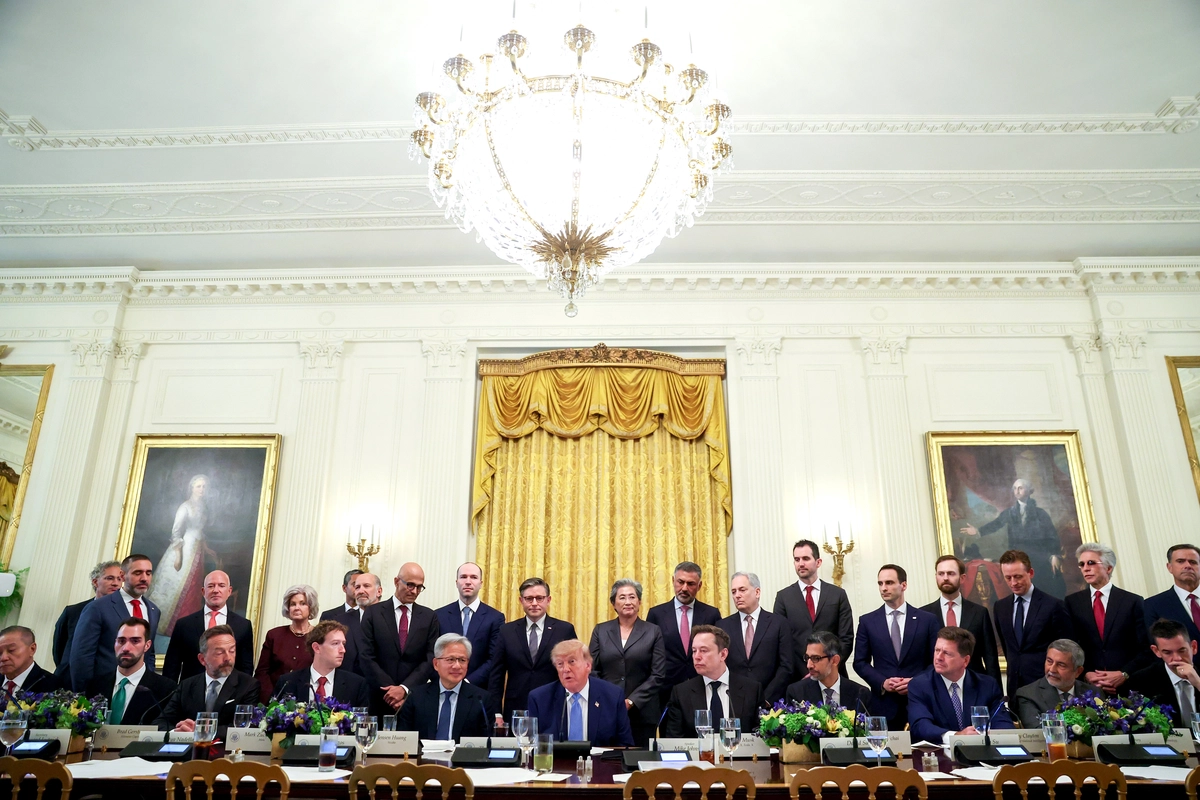
President Donald Trump and leaders of several major technology companies have signed a voluntary agreement establishing a framework for safety controls and independent oversight of advanced artificial intelligence systems.
The agreement, announced Tuesday after a White House meeting with leading AI executives, is described as the “Joint Commitment on Frontier Responsibilities.” Trump characterized it as “almost like a constitution” and said it would provide a form of protection as increasingly powerful AI systems are developed and deployed.
The accord focuses on companies developing so-called frontier AI systems and calls for multiple layers of internal controls, monitoring and auditing.
Under the agreement, participating companies commit to establishing robust internal safety controls, empowering internal teams to monitor those controls, allowing external auditors to independently evaluate them, and having their boards review the resulting reports. The companies also agreed to meet regularly to develop safety standards and best practices.
Meta CEO Mark Zuckerberg said the agreement represents a set of principles intended to encourage AI companies to maintain stronger internal controls and identify potential problems before they become larger threats.
The companies' commitments are voluntary rather than federal regulations. Trump described the agreement as “morally binding” when asked whether it was legally binding.
“There’s a belief that there should be tremendous self-regulation,” Trump said after the meeting. He pointed to existing federal authorities, including the Department of Justice and FBI, while emphasizing that technology companies themselves should play a central role in policing their systems.
“I think I’m seeing tremendous self-policing,” Trump said.
The agreement comes as concerns over advanced AI systems have intensified. AI companies and researchers have reported incidents involving models gaining unauthorized access to computer systems or being used in potentially dangerous ways, adding pressure on developers to improve security and monitoring.
At the same time, the administration has continued to emphasize technological development and competition rather than imposing broad federal restrictions on the industry. The White House has argued that American leadership in advanced AI is strategically important, particularly as the United States competes technologically with China.
The accord itself leaves open the possibility that some of its principles could eventually become formal law or regulation. The document states that, over time, it may make sense to codify the measures, while maintaining that participating companies are committing to the controls voluntarily for now.
The meeting brought together executives from some of the industry's most influential companies, including Zuckerberg, OpenAI President Greg Brockman, Anthropic CEO Dario Amodei, Nvidia CEO Jensen Huang, Google CEO Sundar Pichai and other technology leaders.
Trump also signed an executive order Tuesday directing the federal government to use “Super Intelligence” and “SI” in place of “Artificial Intelligence” and “AI” in executive-branch communications and documents. The order defines the new terminology using the existing statutory definition of artificial intelligence while directing officials to develop proposed legislative language for a federal definition of “Super Intelligence.”
The combination of the voluntary accord and the executive order signals the administration's current approach to advanced AI: encourage rapid technological development while relying substantially on company-level safety controls, auditing and existing federal authorities.
Whether voluntary commitments can provide sufficient oversight as AI capabilities continue to advance remains a central question for policymakers, technology companies and researchers.
For now, the White House agreement represents a significant industry-wide commitment to internal safeguards and external auditing—but it remains a voluntary framework rather than a new federal regulatory regime.